Impress employers and recruiters.
Choose from hundreds of resume examples.
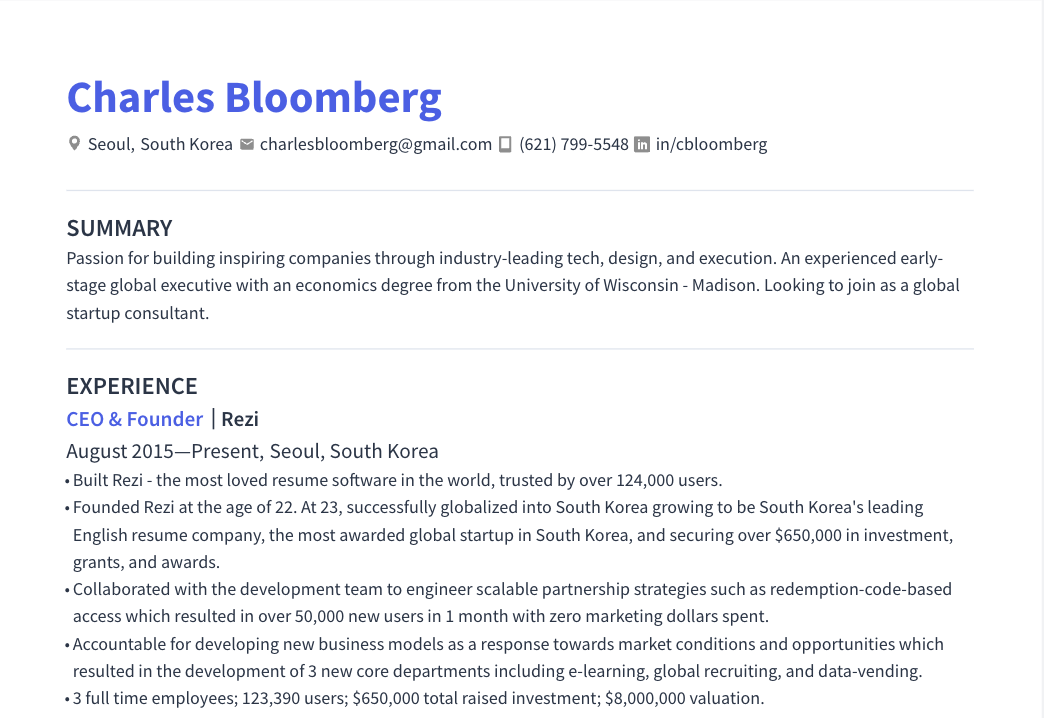
Impress employers and recruiters.
Choose from hundreds of resume examples.
Tailor your resume to this Runtime Lead role.
Rezi rewrites your resume against Efficient Computer's job description. Free.
Tailor your resume to this Runtime Lead role.
Rezi rewrites your resume against Efficient Computer's job description. Free.
Don't guess if your resume is good enough.
See how it scores against the Runtime Lead posting at Efficient Computer — free, in seconds.
Don't guess if your resume is good enough.
See how it scores against the Runtime Lead posting at Efficient Computer — free, in seconds.
About the Role
Efficient Computer is rethinking computing from the ground up to solve AI's biggest challenges: energy. Our Fabric architecture delivers a 10–100x improvement in energy efficiency for general-purpose computation, including AI. We are looking for a Runtime Lead to architect and design the runtime software stack that brings the Fabric to life, from the Linux kernel-mode driver through the user-mode driver and runtime library. You will set the overall technical direction, plan technical work, collaborate with partner teams, and provide technical leadership while staying hands-on. You will take the stack from pre-silicon environments through first silicon to ensure applications run on day one.
Responsibilities
- Provide technical leadership to the engineers who own the kernel-mode driver and the user-mode runtime.
- Guide technical priorities and ownership with the engineering manager.
- Mentor engineers and help interview as the team scales.
- Own the runtime technical roadmap, including scope, milestones, and estimates.
- Work with engineering management on tradeoffs to hit committed dates.
- Raise technical risks early.
- Set the engineering bar for the team, including design reviews, code reviews, coding standards, test strategy, and release practices.
- Build consensus on technical decisions within the team and with partner teams.
- Stay hands-on, contributing code and design to the most critical parts of the stack.
- Own the end-to-end architecture of the runtime software stack: the kernel-mode driver, the HAL and Fabric ABI, the user-mode driver and runtime library, and the interfaces used by ML framework backends.
- Help define the split between kernel and user space.
- Help define the unified memory model between ARM cores and the Fabric accelerator.
- Help define, with the compiler team, the in-memory representations generated by the compiler and consumed by the Fabric.
- Help define, with the help of the firmware and architecture teams, the multi-island task scheduling policy, microcode loading, and the software stack for the embedded risc core.
- Keep the stack layered and portable across device generations and backends.
- Represent the runtime team in architecture, digital design, compiler, embedded, verification, and product forums.
- Bring the software point of view into hardware decisions before tapeout.
- Keep engineering leadership and program management informed on technical status, risks, and decisions.
- Work with product and application teams to turn SDK, framework, and application requirements into runtime priorities.
- Plan and lead bring-up across the full stack, from first boot through first silicon, coordinating kernel and user-mode work.
- Own the runtime quality strategy, including unit tests, conformance tests, regression suites, performance benchmarks, and hardware-in-the-loop validation.
- Serve as the escalation point for the hardest debug problems across kernel and user space.
Requirements
- B.S. in Electrical/Computer Engineering, Computer Science, or equivalent; M.S. or PhD preferred.
- 10+ years of systems software experience, including significant hands-on Linux kernel-mode driver and user-mode runtime library development for accelerators.
- Experience as a technical lead: planning and estimating technical work, mentoring engineers, and delivering against hardware and silicon schedules.
- Experience architecting significant components of a production hw accelerator software stack.
- Deep understanding of memory management across kernel and user space.
- Experience working with compiler teams on binary formats, loaders, JIT vs AOT compilation, launch ABIs, and kernel metadata.
- Strong written and verbal communication; able to represent the team in cross-functional settings and executive reviews, and to influence decisions across hardware and software teams.
- Expert C and C++ and strong Python skills.
- Comfortable working with AI-assisted development tools for code, analysis, and debugging.
- Experience contributing to or leading development of a runtime stack, e.g., CUDA (cudart), ROCm (HIP, ROCr, HSA), Tenstorrent runtime (TT-Metalium), oneAPI Level Zero, OpenCL, or similar accelerator runtime software stack.
- Experience as a technical lead on a first-generation silicon product, where the software stack and the hardware mature together.
- Familiarity with LLVM or MLIR, and with how compilers for accelerators hand off to runtimes.
- Knowledge of dataflow, spatial, or other novel compute architectures, and of how compilers and runtimes target them.
- Experience with FPGA prototyping and hardware emulation platforms.
- Experience with pre-silicon and first-silicon bring-up on ARM platforms.
- Experience with memory-mapped I/O, interrupt handling, and the Linux boot flow.
- Experience with the ARM architecture.
Skills
- Linux kernel-mode driver development
- User-mode runtime library development
- Accelerator software stack architecture
- Kernel and user space interfaces
- Runtime APIs
- ABI design
- HAL design
- Versioning
- Error models
- Device telemetry
- Thread safety
- Synchronization
- Memory management
- Cache coherence
- IOMMU/SMMU configuration
- Unified or shared virtual memory
- Allocators
- Zero-copy data paths
- Binary formats
- Loaders
- JIT compilation
- AOT compilation
- Launch ABIs
- Kernel metadata
- C
- C++
- Python
- AI-assisted development tools
- CUDA
- ROCm
- Tenstorrent runtime
- oneAPI Level Zero
- OpenCL
- LLVM
- MLIR
- Dataflow compute architectures
- Spatial compute architectures
- FPGA prototyping
- Hardware emulation platforms
- Pre-silicon bring-up
- First-silicon bring-up
- ARM platforms
- QEMU
- Emulation environments
- Simulation environments
- Memory-mapped I/O
- Interrupt handling
- Linux boot flow
- ARM architecture
Experience Level
- 10+ years of systems software experience
- Experience as a technical lead
Education Level
- B.S. in Electrical/Computer Engineering, Computer Science, or equivalent
- M.S. or PhD preferred
Salary/Compensations
- $220,000 to $270,000
Benefits
- 10% annual bonus
- Meaningful equity
- Comprehensive benefits
- 401(k) match
- Company-paid benefits
- Paid parental leave
- Flexibility
About the Company
- Efficient Computer is rethinking computing from the ground up to solve one of AI's biggest challenges: energy.
- Our Fabric architecture delivers a 10–100x improvement in energy efficiency for general-purpose computation, including AI, while supporting familiar programming languages and software frameworks—unlocking new possibilities for autonomous machines, intelligent infrastructure, wearables, and space systems.
- With our first processor, Electron E1, now shipping in volume and more than $97 million in Series B financing recently announced, we're accelerating customer deployments and scaling our architecture to data center performance.
- Join us to build the hardware and software that bring intelligence wherever it's needed and help shape the next generation of computing.
- Build what's next.
- At Efficient, you'll tackle big challenges with room to take ownership and make an impact.