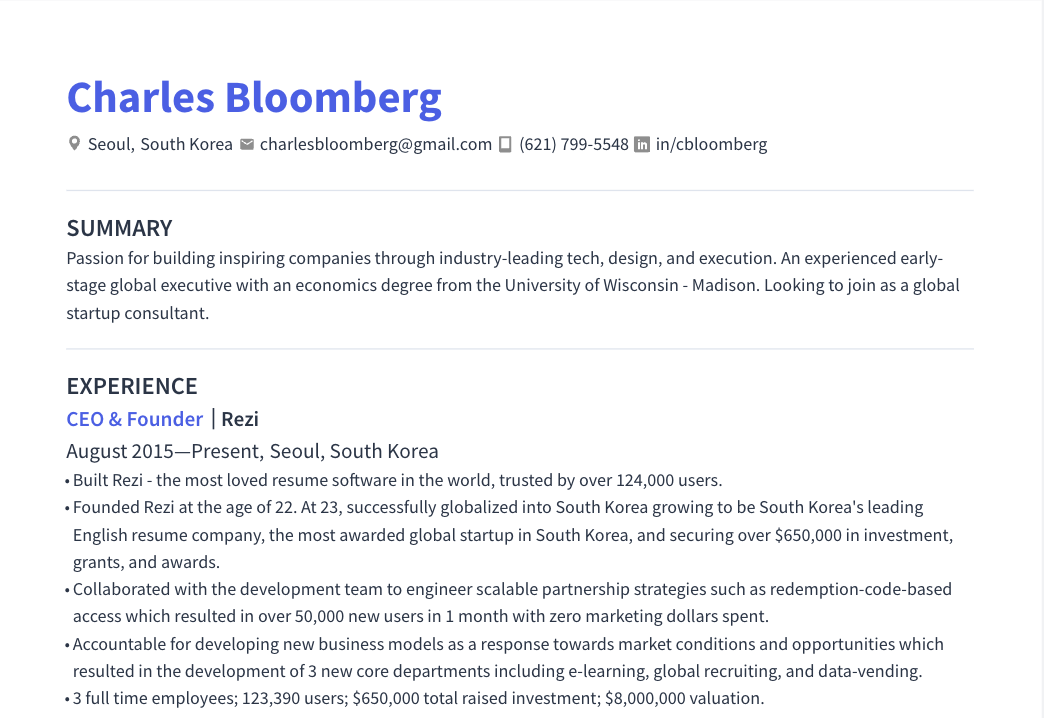
Impress employers and recruiters.
Choose from hundreds of resume examples.
Impress employers and recruiters.
Choose from hundreds of resume examples.
Tailor your resume to this Marine Conservation Intern role.
Rezi rewrites your resume against Environmental Defense Fund's job description. Free.
Tailor your resume to this Marine Conservation Intern role.
Rezi rewrites your resume against Environmental Defense Fund's job description. Free.
Don't guess if your resume is good enough.
See how it scores against the Marine Conservation Intern posting at Environmental Defense Fund — free, in seconds.
Don't guess if your resume is good enough.
See how it scores against the Marine Conservation Intern posting at Environmental Defense Fund — free, in seconds.
About the Role
EDF internships provide high-quality experiences, including relevant projects and networking opportunities, to build a foundation for individuals pursuing environmental careers.
Responsibilities
- Collate, process, and map seabird distribution and fisheries effort datasets to assess spatiotemporal patterns of seabird–fisheries overlap.
- Review scientific literature to compile species-specific catchability estimates, life-history characteristics, and evidence on the effectiveness of seabird bycatch mitigation measures.
- Review existing fisheries regulations and develop and evaluate alternative bycatch mitigation and management scenarios.
- Develop, refine, and implement R code to model the potential effectiveness of different management scenarios in reducing bycatch.
- Support sensitivity analyses to evaluate model assumptions, parameter uncertainty, and the robustness of results.
- Incorporate observed bycatch rates to estimate the number of seabirds caught and potentially saved under different management scenarios.
- Contribute to the preparation of scientific figures, maps, technical reports, and policy-relevant recommendations.
- Communicate with scientific collaborators, seabird tracking data holders, IATTC staff, and partner NGOs to support data acquisition, analysis, and policy engagement.
- Participate in advancing EDF’s organizational effectiveness and culture goals, fostering an inclusive environment where all feel connected, included, and empowered.
Requirements
- Currently enrolled in or recently completed a master's or doctoral degree in ecology, marine science, fisheries science, conservation biology, environmental science, geography, data science, or a related quantitative field.
- Proficiency in R programming (or Python skills and a willingness to work in R), including demonstrated experience in data processing, manipulation, visualization, and statistical analysis.
- Demonstrated experience conducting spatial analyses in R, including working with geospatial data and spatial data packages.
- Strong quantitative and analytical skills, including the ability to independently troubleshoot code and interpret results.
- Experience reviewing and synthesizing scientific literature to inform research questions and analytical approaches.
- Strong organizational skills, attention to detail, and ability to manage multiple tasks and deliver analytical outputs within tight deadlines.
- Excellent written and verbal communication skills, including the ability to disseminate scientific findings clearly to diverse audiences.
- Ability to work both independently and in a team setting.
- Demonstrate self-awareness, cultural competency and inclusivity, and ability to work with colleagues and stakeholders across all cultures and backgrounds.
- Experience analyzing animal tracking, fisheries effort, or other spatially explicit ecological datasets.
- Familiarity with spatial overlap analyses, ecological risk assessments, or quantitative approaches to assessing anthropogenic impacts on wildlife.
- Experience developing or applying statistical models, conducting sensitivity analyses, and quantifying uncertainty.
- Knowledge of seabird ecology, fisheries bycatch, marine policy or marine conservation.
Skills
- R programming
- Python
- Data processing
- Data manipulation
- Data visualization
- Statistical analysis
- Spatial analysis
- Geospatial data
- Scientific literature synthesis
- Quantitative modeling
- Sensitivity analysis
- Scientific communication
Location
- U.S. Remote
- Hybrid (Austin, TX)
- Hybrid (Boulder, CO)
- Hybrid (Boston, MA)
- Hybrid (New York, NY)
- Hybrid (Raleigh, NC)
- Hybrid (San Francisco, CA)
- Hybrid (Washington D.C.)
Work Type
- Full-time (35 hr/week)
- Part-time (20 hr/week)
Experience Level
- Master's degree or Doctoral degree
Education Level
- Master's degree
- Doctoral degree
Salary/Compensations
- $23-24/hr
About the Company
- Healthy oceans are the lifeblood of our planet, but they face growing threats from climate change, overfishing, habitat destruction and other pressures.
- For over 20 years, EDF’s Fisheries & Oceans program has successfully helped fisheries around the world become more sustainable and resilient to climate change.
- We have developed initiatives to protect and restore the ocean’s capacity to sequester atmospheric carbon dioxide, while advancing environmental justice and equity, human welfare and food security.
- Our work is grounded in strong scientific, policy, and economic expertise.
- Bycatch—the incidental capture of non-target species—remains the leading driver of global declines in threatened seabirds, including albatrosses, with tens of thousands of birds killed annually in pelagic longline fisheries.
- Addressing this threat in international waters requires cooperation among fishing nations through Regional Fisheries Management Organizations (RFMOs).
- In the eastern Pacific, seabird bycatch regulations established by the Inter-American Tropical Tuna Commission (IATTC) have not been updated since 2011 and lag behind those of other tuna RFMOs.
- The EDF-led project aims to develop science-based bycatch mitigation strategies, build international consensus and advance targeted policy reform to achieve substantial, long-term reductions in seabird bycatch across the Pacific Ocean.