Impress employers and recruiters.
Choose from hundreds of resume examples.
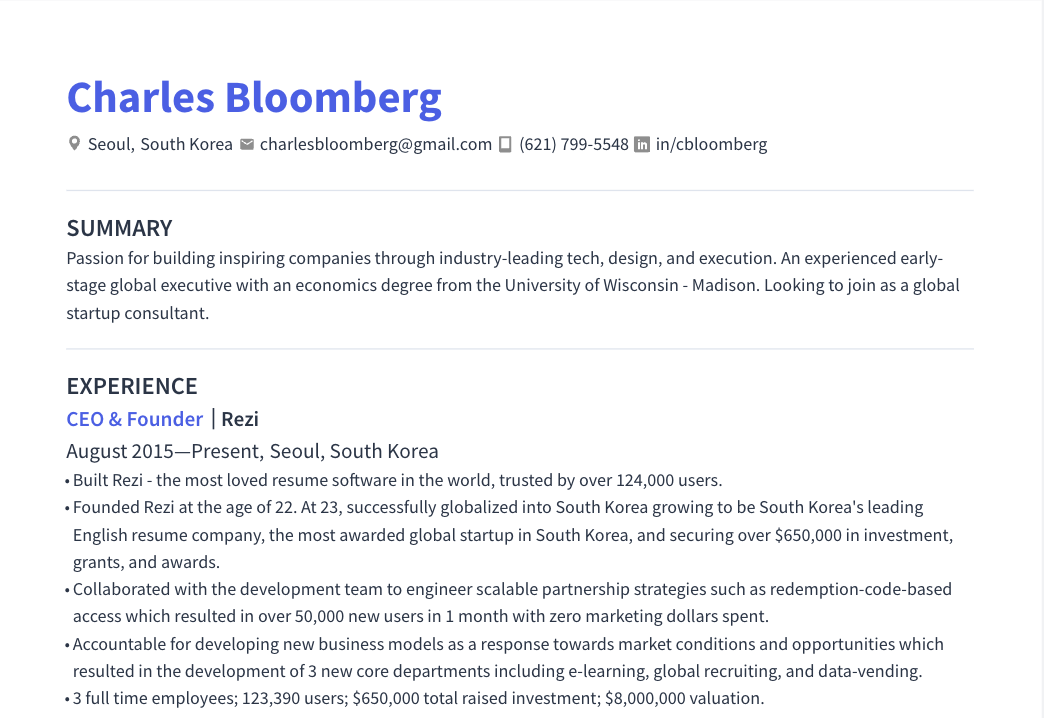
Impress employers and recruiters.
Choose from hundreds of resume examples.
Tailor your resume to this Member of Technical Staff - Inference Runtime role.
Rezi rewrites your resume against Modal's job description. Free.
Tailor your resume to this Member of Technical Staff - Inference Runtime role.
Rezi rewrites your resume against Modal's job description. Free.
Don't guess if your resume is good enough.
See how it scores against the Member of Technical Staff - Inference Runtime posting at Modal — free, in seconds.
Don't guess if your resume is good enough.
See how it scores against the Member of Technical Staff - Inference Runtime posting at Modal — free, in seconds.
About the Role
Modal’s Inference Runtime team owns the container runtime stack for inference and training workloads. We focus on the intersection of Linux, containers, filesystems, storage, GPU drivers, and distributed systems to ensure ML workloads start quickly, run efficiently, and remain securely isolated. We are seeking a systems engineer to build production runtime infrastructure in Rust and Go, diagnose Linux and performance issues, and contribute to the architecture of Modal’s container platform, including potential contributions to gVisor.
Responsibilities
- Make container startup, checkpoint, and restore dramatically faster for large inference and training workloads.
- Build multi-GPU and accelerator-aware snapshotting, including efficient handling of GPU memory and RDMA-enabled workloads.
- Design zero-copy and low-copy data paths between container memory, filesystems, storage, and Modal’s runtime.
- Optimize large snapshot pipelines using techniques such as parallel uploads, direct I/O, incremental snapshots, and more efficient memory handling.
- Improve container image and filesystem performance across EROFS, FUSE, page caches, overlay filesystems, and remote storage.
- Extend our sandboxed runtime to support new GPUs, drivers, profiling tools, and device capabilities across NVIDIA and AMD hardware.
- Debug complex failures involving system calls, virtual memory, process lifecycle, kernel behavior, GPU drivers, and container isolation.
- Safely roll out runtime and kernel changes across a heterogeneous fleet using compatibility controls, scheduling constraints, feature flags, and observability.
- Work across the runtime, scheduler, storage, and GPU infrastructure—and take ambiguous production problems from investigation through deployment.
Requirements
- Strong Linux systems knowledge, particularly processes, virtual memory, filesystems, system calls, scheduling, namespaces, cgroups, and signals.
- Experience building or debugging container runtimes, sandboxes, Linux kernel, or similarly low-level infrastructure.
- Strong programming ability in Rust, Go, or another systems language, with an interest in becoming productive in both Rust and Go.
- Experience profiling and improving systems where memory movement, I/O, synchronization, or kernel interactions dominate performance.
- Comfort debugging across abstraction boundaries, from application behavior down through runtimes, drivers, and the kernel.
- An ability to turn loosely defined production problems into well-designed, reliable systems.
- A desire to own important infrastructure and work closely with both internal teams and customers.
Skills
- Rust
- Go
- Linux systems
- Container runtimes
- Sandboxes
- Linux kernel
- Systems programming
- Performance profiling
- Debugging
- gVisor
- runsc
- runc
- OCI runtimes
- seccomp
- checkpoint/restore systems
- CUDA
- ROCm
- GPU drivers
- RDMA
- FUSE
- EROFS
- direct I/O
- mmap
- page-cache behavior
- storage engines
About the Company
- The container runtime is directly on the critical path for inference performance. Improvements here can substantially reduce cold starts, increase token throughput, unlock new accelerator types, and make previously impractical workloads possible.
- This is an opportunity to work on unusually deep systems problems with immediate production impact.
- You’ll have room to shape the architecture, contribute to open-source runtime technology, and take ownership of foundational infrastructure used by every inference and training workload on Modal.