Impress employers and recruiters.
Choose from hundreds of resume examples.
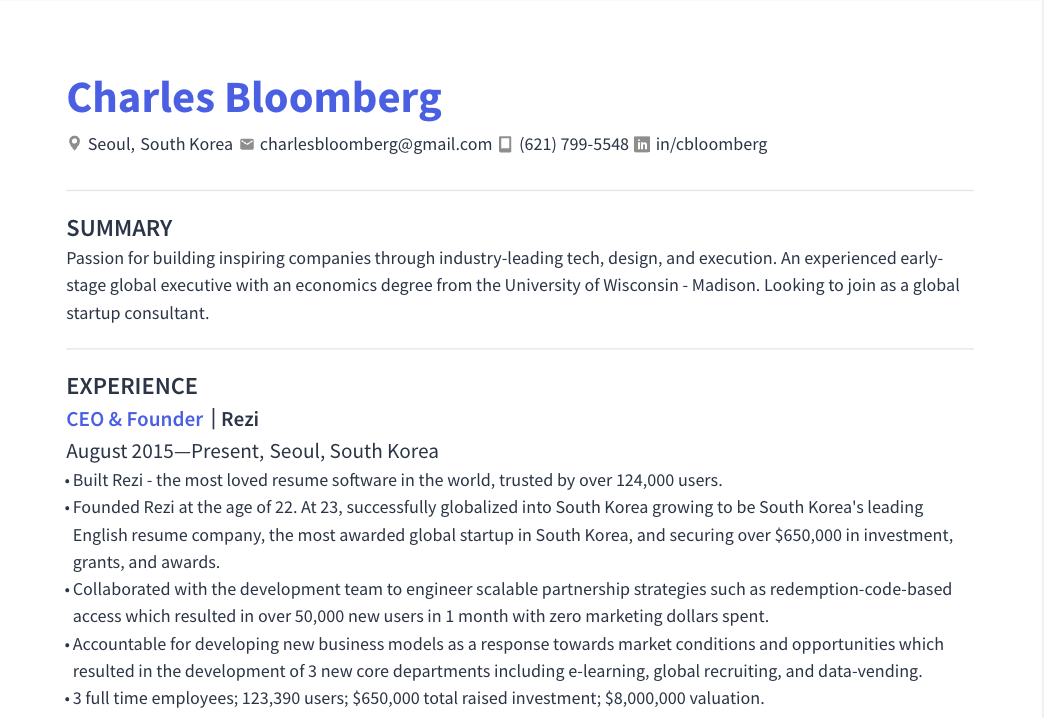
Impress employers and recruiters.
Choose from hundreds of resume examples.
Tailor your resume to this Senior Fiber Optic Gyroscope Engineer role.
Rezi rewrites your resume against Advanced Navigation's job description. Free.
Tailor your resume to this Senior Fiber Optic Gyroscope Engineer role.
Rezi rewrites your resume against Advanced Navigation's job description. Free.
Don't guess if your resume is good enough.
See how it scores against the Senior Fiber Optic Gyroscope Engineer posting at Advanced Navigation — free, in seconds.
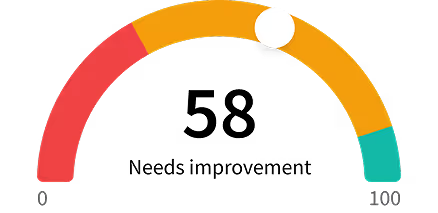
Don't guess if your resume is good enough.
See how it scores against the Senior Fiber Optic Gyroscope Engineer posting at Advanced Navigation — free, in seconds.
About the Role
This role supports the development, verification, and continuous improvement of Fiber Optic Gyroscope (FOG) technologies and their integration into inertial navigation systems. The Senior Fiber Optic Gyroscope Engineer applies strong analytical and practical engineering skills across optical components, fiber coils, gyro performance, environmental testing, and system-level troubleshooting, collaborating with multidisciplinary teams to translate test results into engineering actions.
Responsibilities
- Support the design, development, integration, and verification of FOG and related optical subsystems.
- Analyze FOG and IMU performance, including bias, bias instability, angle random walk, scale factor, linearity, noise, and thermal behavior.
- Plan and conduct optical, environmental, and system-level tests to characterize performance and identify improvement opportunities.
- Investigate technical issues using structured root-cause analysis and develop clear troubleshooting and verification plans.
- Evaluate the performance of optical components, fiber coils, and integrated optical paths using relevant measurement techniques and test equipment.
- Interpret test data and identify relationships between optical, electronic, mechanical, thermal, and algorithmic parameters.
- Define acceptance criteria, test checkpoints, and characterization methods for components, subassemblies, and completed units.
- Support the development and improvement of FOG test infrastructure, analysis tools, and engineering processes.
- Work closely with manufacturing and production engineering teams to improve repeatability, yield, and product performance.
- Contribute to design reviews, failure investigations, risk assessments, and technical documentation.
- Provide technical guidance and knowledge sharing to other engineers and support the development of team capability.
- Maintain clear traceability between requirements, design decisions, test results, and corrective actions.
Requirements
- Degree in Physics, Optical Engineering, Electrical Engineering, Mechatronics, or a related technical discipline.
- Strong experience in fiber optics, photonic systems, optical sensing, inertial sensors, or a closely related field.
- Demonstrated ability to analyze complex test data and translate findings into practical engineering actions.
- Experience with optical measurement equipment and laboratory-based testing.
- Strong understanding of experimental design, measurement uncertainty, and structured troubleshooting.
- Ability to work independently on technically complex investigations while collaborating effectively across multidisciplinary teams.
- Strong technical communication and documentation skills.
- Ability to explain complex technical findings clearly to engineering, manufacturing, and project stakeholders.
Skills
- Fiber optics
- Photonic systems
- Optical sensing
- Inertial sensors
- Optical measurement equipment
- Laboratory-based testing
- Experimental design
- Measurement uncertainty
- Structured troubleshooting
- Technical communication
- Documentation
- FOG optical architecture
- Light sources
- Couplers
- Integrated optical components
- Photodetectors
- Polarization-maintaining fiber
- Fiber coil characterization
- Winding-related parameters
- Polarization behavior
- Insertion loss
- Optical power measurements
- Closed-loop gyro operation
- Modulation techniques
- Signal processing
- Control principles
- Inertial sensor performance analysis
- Environmental effects analysis (temperature, vibration, magnetic fields, mechanical stress)
- IMU or INS integration, calibration, and validation
- MATLAB
- Python
- LabVIEW
- Data analysis
- Test automation
- Communication skills
- Interpersonal skills
- Collaboration
- Problem solving
- Continuous improvement
- Ownership mindset
- Accountability
- Knowledge sharing
- Mentoring
Experience Level
- Senior
Education Level
- Degree in Physics, Optical Engineering, Electrical Engineering, Mechatronics, or a related technical discipline