Impress employers and recruiters.
Choose from hundreds of resume examples.
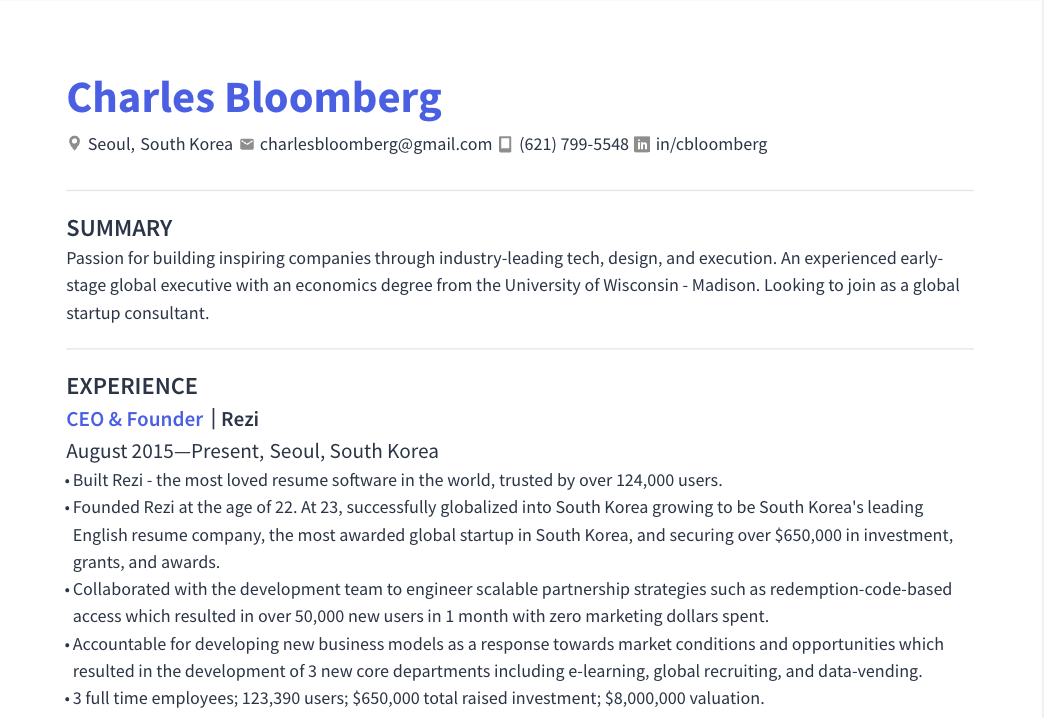
Impress employers and recruiters.
Choose from hundreds of resume examples.
Tailor your resume to this Sr. Director, Business Intelligence and Analytics role.
Rezi rewrites your resume against GS1 Canada's job description. Free.
Tailor your resume to this Sr. Director, Business Intelligence and Analytics role.
Rezi rewrites your resume against GS1 Canada's job description. Free.
Don't guess if your resume is good enough.
See how it scores against the Sr. Director, Business Intelligence and Analytics posting at GS1 Canada — free, in seconds.
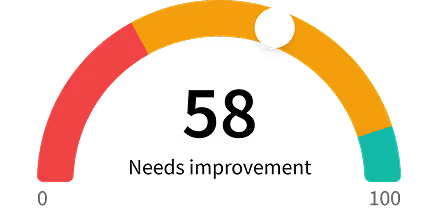
Don't guess if your resume is good enough.
See how it scores against the Sr. Director, Business Intelligence and Analytics posting at GS1 Canada — free, in seconds.
About the Role
The Senior Director, Business Intelligence and Analytics is a senior enterprise leader responsible for building and leading GS1 Canada’s business intelligence, analytics, and market insight capability. The role provides the organization with a clear, trusted, and evidence-based view of strategic performance, subscriber growth and retention, product and service adoption, sector opportunity, and emerging market dynamics. This leader will establish the roadmap, operating model, capabilities, and governance needed to embed AI into analytical workflows, improve insight speed, quality, and reach, and equip the team and business leaders to use AI effectively and responsibly.
Responsibilities
- Build, lead, and mature GS1 Canada’s business intelligence and analytics capability, including enterprise reporting, subscriber and sector analytics, product and service usage analytics, market intelligence, and growth insights.
- Establish a trusted and consistent single version of the truth by aligning data definitions, metrics, dashboards, and reports across business units.
- Lead enterprise dashboards, executive scorecards, and recurring insight products covering subscriber growth, retention, churn, adoption, engagement, service usage, sector penetration, revenue performance, and strategic execution.
- Advance the function from descriptive reporting to diagnostic, predictive, and prescriptive insight that identifies drivers, anticipates risks and opportunities, and recommends action.
- Establish standards for analytical quality, metric definitions, dashboard governance, documentation, reproducibility, and executive communication.
- Partner with Technology, Data Governance, and business teams to improve data accessibility, quality, reliability, and fitness for analytical and AI use.
- Build an integrated intelligence capability that combines subscriber and operational data, sector insight, competitive intelligence, and external market trends.
- Monitor changes in subscriber expectations, digital and agentic commerce, product data management, regulation, sustainability, 2D barcode adoption, AI-enabled data management, and other developments affecting GS1 Canada’s relevance and growth.
- Synthesize quantitative and qualitative signals from sector boards, working groups, subscriber interactions, support channels, research, and industry forums in partnership with relevant business teams.
- Identify enterprise-wide patterns and sector-specific needs, and provide regular executive briefings on market shifts, subscriber expectations, competitors, opportunities, and strategic risks.
- Recommend where insights indicate a need to adjust strategic focus, product priorities, positioning, education, or market engagement.
- Define and maintain the enterprise KPI framework, aligned to strategy, subscriber value, growth, adoption, financial performance, and operational outcomes.
- Set consistent definitions and ownership for core measures, including subscriber growth, retention, churn, engagement, adoption, product and service usage, sector penetration, revenue trends, and strategic progress.
- Partner with Finance and functional leaders to ensure measures are reliable, decision-useful, and consistently applied across executive, functional, and sector reporting.
- Identify gaps or inconsistencies in measurement and recommend improvements to data, instrumentation, reporting, and accountability.
- Focus leadership attention on the few measures that matter most, connecting activity to subscriber outcomes, growth impact, and strategic value.
- Develop and execute a multi-year roadmap to transform the analytics function through AI, aligned with enterprise strategy, the AI Council, and GS1 Canada’s technology and data priorities.
- Prioritize high-value use cases such as automated data preparation and reporting, insight synthesis, anomaly detection, forecasting, segmentation, churn and propensity analysis, and conversational or self-service analytics.
- Redesign analyst workflows and roles to combine automation with human judgment, enabling the team to spend less time producing reports and more time interpreting results, advising leaders, and driving action.
- Establish a disciplined path from experimentation to production, including use-case intake, value assessment, pilots, validation, adoption planning, controls, and scaling.
- Partner with Technology and Data Governance on approved tools, architecture, secure data access, semantic models, data quality, integration, and production support; retain business ownership of analytical use cases, adoption, and outcomes.
- Partner with the AI Council, Privacy, Legal, Cybersecurity, and Data Governance to ensure appropriate human oversight, transparency, confidentiality, intellectual property protection, bias testing, accuracy, and responsible use.
- Build team capability in AI-assisted analysis, prompt and context design, model limitations, validation, documentation, and effective human review.
- Measure transformation value through adoption, time-to-insight, productivity, analytical quality, decision impact, and measurable business outcomes.
- Prepare executive and Board materials that clearly communicate strategic progress, performance trends, subscriber outcomes, growth opportunities, and emerging risks.
- Translate complex analysis into concise narratives that connect metrics to strategy, market conditions, implications, and decisions required.
- Support executive decision-making by identifying the most important insights, dependencies, risks, options, and recommended actions.
- Serve as a trusted enterprise advisor by providing balanced, objective, transparent, and analytically rigorous insight.
- Act as a strategic partner to Product, Subscriber Management, Finance, Marketing, Industry Relations, Community Engagement, Technology, Operations, and Data Governance.
- Provide Product and Subscriber Management with insight on adoption, usage, lifecycle performance, acquisition, retention, churn, account health, sector performance, and growth potential.
- Support Marketing, Product Marketing, Industry Relations, and Community Engagement with analysis of awareness, engagement, campaign effectiveness, market positioning, sector signals, and subscriber sentiment.
- Align revenue and performance analytics with Finance while preserving Finance’s accountability for budgeting, forecasting, accounting, and financial controls.
- Promote a culture in which data, evidence, and insight consistently shape leadership discussions, priorities, and resource decisions.
- Define the team structure, roles, capabilities, workflows, service model, and operating rhythms required for a modern enterprise analytics function.
- Coach analysts to progress from report production to insight generation, storytelling, analytical judgment, business partnership, and strategic advisory work.
- Set clear objectives and quality standards, manage performance, allocate capacity to the highest-value work, and establish transparent intake and prioritization practices.
- Create a high-performance culture grounded in curiosity, objectivity, experimentation, collaboration, accountability, and subscriber value.
- Develop talent, succession plans, and future-ready skills across business intelligence, analytics, market intelligence, and AI.
Requirements
- 10+ years of progressive experience in business intelligence, analytics, market intelligence, enterprise performance, strategy, or related business leadership roles.
- Demonstrated experience building or transforming a business intelligence or analytics function, including changes to operating models, processes, tools, and team capabilities.
- Demonstrated experience leading the adoption of AI, machine learning, automation, or advanced analytics in business workflows and taking use cases from pilot to sustained use.
- Experience leading and developing analysts and influencing cross-functional teams in a complex organization.
- Proven ability to translate data and market signals into executive-level insight, decisions, and strategic recommendations.
- Experience developing enterprise KPIs, dashboards, scorecards, performance frameworks, and self-service analytics.
- Experience analyzing customer or subscriber behaviour, retention, churn, adoption, engagement, revenue trends, market opportunity, or product and service performance.
- Experience supporting executive leadership and Board-level reporting.
- Experience in B2B, data services, SaaS, digital commerce, retail, healthcare, supply chain, standards, or member- or subscriber-based organizations is an asset.
Skills
- Enterprise strategy
- Business intelligence
- Analytics
- Performance management
- Practical AI applications in analytics
- Generative AI
- Predictive methods
- Automation
- Conversational analytics
- Human-in-the-loop control
- Change leadership
- Analytical judgment
- Business narrative translation
- Executive-ready insights
- Actionable recommendations
- Subscriber or customer analytics
- Segmentation
- Adoption
- Engagement
- Retention
- Churn
- Lifetime value
- Market opportunity
- People leadership
- Executive communication
- Board-level writing
- Presentation
- Data storytelling
- Facilitation
- Cross-functional collaboration
- Influence without direct authority
- Data governance
- Privacy
- Security
- Responsible AI
- Metric consistency
- Reporting standards
- Analytical quality control
- Ability to build structure
Location
- Toronto, ON
Work Type
- Full Time
Experience Level
- 10+ years
Salary/Compensations
- CA$145,000 - CA$165,000 / year
About the Company
- GS1 Canada is an organization focused on business intelligence, analytics, and market insight.