Impress employers and recruiters.
Choose from hundreds of resume examples.
Impress employers and recruiters.
Choose from hundreds of resume examples.
Tailor your resume to this Manager Engineering & Sr Data Architect role.
Rezi rewrites your resume against The Doctors Company's job description. Free.
Tailor your resume to this Manager Engineering & Sr Data Architect role.
Rezi rewrites your resume against The Doctors Company's job description. Free.
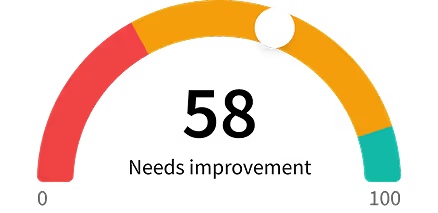
Don't guess if your resume is good enough.
See how it scores against the Manager Engineering & Sr Data Architect posting at The Doctors Company — free, in seconds.
Don't guess if your resume is good enough.
See how it scores against the Manager Engineering & Sr Data Architect posting at The Doctors Company — free, in seconds.
About the Role
Lead the Data and AI architecture and engineering function as a technical manager, owning Microsoft Fabric architecture, enterprise data and semantic modeling, integration design, and governed AI enablement while building an engaged, capable, and accountable team.
Responsibilities
- Clearly define and communicate team roles, expectations, and responsibilities.
- Provide coaching, guidance, and support to help employees achieve performance and development goals.
- Deliver consistent, constructive, feedback to recognize achievements, address challenges, and reinforce desired behaviors.
- Conduct regular 1:1 meeting and ensure timely completion of performance review cycles, maintaining alignment and accountability.
- Hold staff accountable for compliance with organizational policies and standards.
- Foster a culture of continuous learning, innovation, and accountability by encouraging team members to pursue new challenges and opportunities.
- Model and reinforce organizational values, actively recognizing and celebrating behaviors that exemplify them.
- Own the end-to-end Microsoft Fabric reference architecture across OneLake, Lakehouse, Warehouse, Pipelines, Dataflows Gen2, notebooks, Real-Time Intelligence, Power BI, workspaces, domains, and capacities.
- Lead the team delivering foundational Fabric patterns and priority platform components; stay hands-on for high-risk design, prototyping, review, and troubleshooting.
- Define medallion, batch, CDC, streaming, mirroring, shortcut, deployment, security, monitoring, and capacity-management patterns.
- Maintain current architecture diagrams, standards, roadmaps, architecture decisions, and implementation guardrails.
- Own conceptual, logical, physical, canonical, dimensional, and enterprise semantic model standards across policy, claims, provider, patient safety, underwriting, actuarial, and finance domains.
- Establish Power BI semantic model standards for measures, calculation groups, naming, certified datasets, reuse, refresh, performance, lineage, ownership, and RLS/OLS/CLS.
- Define data contracts, model versioning, metadata, glossary, master/reference data, ontology, and knowledge-graph alignment.
- Design secure integrations across Fabric, Azure, operational systems, content platforms, and external providers using APIs, events, CDC, streaming, files, and batch patterns.
- Establish Git-based delivery, pull-request review, automated testing, CI/CD, environment promotion, release, rollback, observability, incident response, and operational-readiness standards.
- Define service objectives and telemetry for pipelines, capacities, semantic models, AI services, and critical data products; lead root-cause analysis and durable remediation without blame.
- Embed least privilege, secrets management, PHI/PII controls, sensitivity, retention, data quality, lineage, auditability, and responsible AI controls into delivery patterns.
- Forecast, monitor, explain, and optimize platform capacity, compute, storage, licensing, and vendor cost against business value.
- Translate strategy and ambiguous business needs into decision-ready options, recommendations, diagrams, roadmaps, staffing plans, and executable work for technical and executive audiences.
- Partner with Enterprise Architecture, Security, Infrastructure, Governance, Claims, Underwriting, Actuarial, Reporting, Legal/Compliance, Finance, and vendors to resolve tradeoffs and dependencies.
- Communicate risks early with context, impact, options, and a recommended action; represent decisions with composure, transparency, and sound judgment.
- Lead adoption of architecture standards and new ways of working through stakeholder engagement, education, measurement, and reinforcement.
- Maintain full compliance with all organizational policies, procedures, and established standards.
- Keep technical knowledge and skills current to effectively support department priorities.
- Complete all performance and development activities – including the performance review process – in a timely manner.
- Fulfill all required training and development obligations to maintain essential skills and credentials.
- Complete all mandator compliance courses on time, meeting corporate training standards.
- Pursue additional learning opportunities that strengthen professional capabilities and contribute to team and organizational performance, with prior manager approval.
Requirements
- Bachelor's or master's degree in Computer Science, Data Engineering, Information Systems, Software Engineering, or a related field; equivalent experience considered.
- 10+ years of deep enterprise data, analytics, engineering, or architecture experience with accountability for architecture decisions in production.
- 3+ years directly managing and supervising data engineers, analytics engineers, architects, or similar technical staff, including managing a team through change.
- Direct accountability for hiring, onboarding, goal setting, performance reviews, coaching, career development, workload planning, succession planning, employee relations, and retention.
- Constructive, solution-oriented leadership and strong executive communication.
- Regulated-industry experience (insurance, healthcare, or financial services) preferred.
Skills
- Microsoft Fabric (OneLake, Lakehouse, Warehouse, Pipelines, Dataflows Gen2, notebooks, Real-Time Intelligence, Power BI, workspaces, security, and capacity governance)
- Enterprise data and semantic modeling: conceptual, logical, physical, dimensional, and canonical models; data contracts; Power BI semantic models; lineage; RLS/OLS/CLS; and performance tuning.
- SQL
- Python
- PySpark
- Delta Lake
- Batch processing
- Change Data Capture (CDC)
- Streaming data processing
- API development
- DataOps
- Automated testing
- Continuous Integration/Continuous Deployment (CI/CD)
- Observability
- Cost management
- Microsoft Fabric architecture
- Medallion architecture
- Mirroring
- Shortcuts
- Deployment strategies
- Security protocols
- Monitoring systems
- Capacity management
- Conceptual data modeling
- Logical data modeling
- Physical data modeling
- Canonical data modeling
- Dimensional data modeling
- Enterprise semantic modeling
- Power BI semantic models
- Measures
- Calculation groups
- Naming conventions
- Certified datasets
- Dataset reuse
- Data refresh strategies
- Performance optimization
- Data lineage tracking
- Data ownership
- Row-Level Security (RLS)
- Object-Level Security (OLS)
- Column-Level Security (CLS)
- Data contracts
- Model versioning
- Metadata management
- Data glossary creation
- Master data management
- Reference data management
- Ontology development
- Knowledge graph alignment
- Secure integration design
- Azure services integration
- Operational systems integration
- Content platforms integration
- External provider integration
- Event-driven architecture
- File-based data transfer
- Batch data transfer
- Git-based delivery workflows
- Pull-request reviews
- Automated testing frameworks
- CI/CD pipelines
- Environment promotion strategies
- Release management
- Rollback procedures
- Observability tools
- Incident response planning
- Operational readiness assessment
- Service level objectives (SLO) definition
- Telemetry implementation
- Root-cause analysis
- Durable remediation strategies
- Least privilege access control
- Secrets management
- Protected Health Information (PHI) controls
- Personally Identifiable Information (PII) controls
- Data sensitivity classification
- Data retention policy implementation
- Data quality assurance
- Auditability controls
- Responsible AI implementation
- Platform capacity forecasting
- Compute resource monitoring
- Storage resource monitoring
- Licensing management
- Vendor cost optimization
- Business value alignment
- Strategic planning
- Business needs translation
- Decision-ready option development
- Recommendation formulation
- Diagram creation
- Roadmap development
- Staffing plan creation
- Work execution planning
- Technical audience communication
- Executive audience communication
- Enterprise Architecture collaboration
- Security team collaboration
- Infrastructure team collaboration
- Governance team collaboration
- Claims department collaboration
- Underwriting department collaboration
- Actuarial department collaboration
- Reporting department collaboration
- Legal/Compliance department collaboration
- Finance department collaboration
- Vendor management
- Tradeoff resolution
- Dependency management
- Risk communication
- Impact assessment
- Option analysis
- Action recommendation
- Decision representation
- Composure
- Transparency
- Sound judgment
- Architecture standards adoption
- New ways of working implementation
- Stakeholder engagement
- Educational initiatives
- Performance measurement
- Behavioral reinforcement
- Organizational policy compliance
- Procedure adherence
- Established standard adherence
- Time recording accuracy
- Paid time off (PTO) submission
- Mandatory corporate training completion
- Technical knowledge maintenance
- Skill currency maintenance
- Department priority support
- Performance activity completion
- Development activity completion
- Performance review process completion
- Training obligation fulfillment
- Credential maintenance
- Compliance course completion
- Corporate training standard adherence
- Learning opportunity pursuit
- Professional capability enhancement
- Team performance contribution
- Organizational performance contribution
- Manager approval for learning opportunities
Location
- New York City
- Any other TDC Group or ProAssurance office location
Work Type
- Hybrid
Experience Level
- 10+ years of deep enterprise data, analytics, engineering, or architecture experience
- 3+ years directly managing and supervising data engineers, analytics engineers, architects, or similar technical staff
Education Level
- Bachelor's or master's degree in Computer Science, Data Engineering, Information Systems, Software Engineering, or a related field; equivalent experience considered.
Salary/Compensations
- $124,548 - $163,879
- This position is eligible for participation in the Company's Short-Term Incentive Plan (STIP), offering additional compensation driven by individual and company performance.
- Compensation is determined based on factors such as skills, experience, education, and market considerations.
- Salary may also include additional geographic differential for employees working in higher-cost labor markets, including states such as New York and California.
Benefits
- Medical leave
- Family leave
- Bereavement leave
- Same-sex domestic partner benefits
- Short-term disability programs
- Long-term disability programs
- Employee assistance program
- Health insurance
- Dental insurance
- Vision insurance
- Health care tax-free spending accounts with a company match
- 401(k) with company match
- Roth IRA with company match
- Catch-up plans for 401(k) and Roth IRA
- Vacation days
- Sick days
- Paid personal days
- Paid holidays
- Life insurance
- Travel insurance
- Tax-free commuter benefits
- In-person learning opportunities
- Online learning opportunities
- Cross-function career opportunities
- Business casual work environment
- Time off to volunteer
- Matching donations to qualifying nonprofit organizations
- Company-sponsored participation at non-profit events
About the Company
- The Doctors Company is the nation’s largest physician-owned medical malpractice insurer.
- Founded and led by physicians, we are committed to advancing, protecting, and rewarding the practice of good medicine.
- The Doctors Company is proud to be Certified™ by Great Place to Work®.