Impress employers and recruiters.
Choose from hundreds of resume examples.
Impress employers and recruiters.
Choose from hundreds of resume examples.
Tailor your resume to this Corporate Vice President - Data Architecture role.
Rezi rewrites your resume against New York Life's job description. Free.
Tailor your resume to this Corporate Vice President - Data Architecture role.
Rezi rewrites your resume against New York Life's job description. Free.
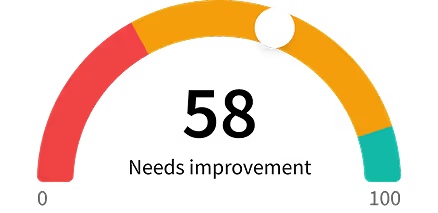
Don't guess if your resume is good enough.
See how it scores against the Corporate Vice President - Data Architecture posting at New York Life — free, in seconds.
Don't guess if your resume is good enough.
See how it scores against the Corporate Vice President - Data Architecture posting at New York Life — free, in seconds.
About the Role
The Corporate Vice President, Data Architecture provides senior data architecture leadership across Enterprise Plan to Perform (EPP) and AI-led Portfolio Management. This role is accountable for defining and governing the target-state data architecture that enables these strategic transformations, ensuring trusted enterprise data is organized, modeled, governed, connected, accessed, and made usable by applications, analytics, and AI agents. The leader will establish cross-bet data architecture principles, canonical and semantic models, data-product boundaries, source-of-truth patterns, lineage and provenance requirements, and the architectural approach to consolidation, federation, replication, APIs, and runtime access. This role requires making consequential architecture decisions, resolving cross-domain data issues, influencing senior leaders, and establishing an AI-native data architecture that preserves trust, quality, governance, and deterministic access while enabling agents to securely discover, retrieve, interpret, and compose information across enterprise sources.
Responsibilities
- Own the target-state data architecture across EPP and AI-led Portfolio Management, ensuring coherent, reusable, and enterprise-aligned data foundations.
- Establish data architecture principles, reference patterns, decision frameworks, and guardrails for data products, semantic models, data movement, access, integration, storage, federation, and consumption.
- Drive consequential decisions regarding authoritative sources, canonical models, source-of-truth patterns, consolidation versus federation, real-time versus replicated data, and reuse across domains.
- Identify and resolve cross-domain and cross-bet data dependencies before they become delivery constraints.
- Provide senior architecture leadership on major data investments, balancing business value, speed, scalability, reliability, cost, risk, and long-term sustainability.
- Define the architecture and boundaries for governed enterprise data products supporting the two strategic bets.
- Establish canonical and semantic models, business definitions, and reusable metric patterns for consistent information interpretation.
- Define expectations for lineage, provenance, freshness, quality, traceability, metadata, and source attribution.
- Partner with business data owners, Finance, Investments, and enterprise data-governance teams to clarify ownership and stewardship of critical data and metrics.
- Ensure critical deterministic use cases have reliable, governed, and production-ready data paths.
- Establish data-access patterns for AI and agentic solutions, including secure discovery, retrieval, interpretation, and combination of trusted enterprise information.
- Define when data should be curated and persisted as a deterministic data product versus accessed dynamically.
- Shape architectures for combining structured and unstructured information.
- Define architecture patterns for agent identity, entitlements, provenance, citations, and traceability.
- Partner with AI, platform, Security, and Risk teams to ensure AI data access supports responsible AI, privacy, control, and audit requirements.
- Continuously evaluate emerging data and AI architecture patterns and determine their practical applicability.
- Own the cross-domain data architecture supporting EPP capabilities like Expense Management, Planning & Projections, Performance Management, NEXUS, Capital, NII, Driver-Based Modeling, and Scenario Analysis.
- Ensure consistent definitions and architectural patterns for enterprise and business performance metrics, financial drivers, plans, forecasts, actuals, scenarios, and management insights.
- Partner with the Performance Technology Lead and EPP Domain Technology Leads to translate business and technology requirements into scalable data architecture.
- Define how NEXUS accesses deterministic metrics, analytical data, contextual information, and agentic data sources.
- Shape data architecture for source platforms such as planning and financial systems.
- Own the cross-domain data architecture supporting AI-led Portfolio Management capabilities.
- Define how structured investment data, proprietary information, research, market information, and unstructured content can be governed and made accessible.
- Partner with Portfolio Management Domain Technology Leads and the Solution Engineering & Architecture Lead to establish reusable data patterns.
- Ensure investment data required by downstream Finance and EPP capabilities can be connected through governed, traceable, and scalable patterns.
- Balance the distinctive data needs of public and private markets with opportunities for common enterprise architecture and reuse.
- Partner closely with the two Solution Engineering & Architecture Leads, retaining accountability for cross-bet data architecture and data patterns.
- Jointly resolve architecture decisions where application, agent, integration, and data architecture intersect.
- Partner with Domain Technology Leads to ensure data architecture supports end-to-end technology capability and business outcomes.
- Provide architectural direction to the federated Data Engineering Lead and TDAV data-engineering teams.
- Work with enterprise data architecture, governance, platform, and cloud teams to align strategic-bet needs with enterprise standards.
- Use targeted prototypes and proofs of concept to validate critical data-architecture assumptions.
- Partner with engineering teams to turn architecture into reusable, production-ready patterns.
- Create clear architecture decisions, reference implementations, and guidance.
- Review major data designs for alignment with the target architecture.
- Continuously incorporate evidence from delivery into the evolution of data architecture principles and patterns.
- Communicate complex data architecture choices and tradeoffs clearly to senior business and technology executives.
- Partner with Security, Privacy, Risk, Compliance, Audit, and control functions to ensure data architectures incorporate appropriate governance, entitlements, resiliency, auditability, and regulatory requirements.
- Create transparency around material data dependencies, architecture risks, technical debt, and investment decisions.
- Help shape the broader enterprise perspective on how AI changes data-product and consolidation strategies.
- Maintain an external perspective on modern data architecture, data products, semantic technologies, AI-native data patterns, and financial-services practices.
- Build, lead, and develop high performing teams with strong domain knowledge and modern technology and engineering capabilities.
- Attract, develop, and retain forward-deployed and other high-caliber technology talent.
- Establish clear accountability and a culture of collaboration, innovation, engineering discipline, and continuous improvement.
Requirements
- 15+ years of progressively responsible experience in data architecture, data engineering, enterprise architecture, technology architecture, data platforms, analytics, or related disciplines, including significant leadership responsibility for complex enterprise data ecosystems.
- Proven experience defining target-state data architecture across multiple domains, applications, and business capabilities within a large, complex enterprise.
- Demonstrated expertise with enterprise data products, canonical and semantic modeling, metadata, lineage, data quality, governance, and source-of-truth patterns.
- Strong experience designing modern data architectures spanning cloud data platforms, APIs, integration, streaming or real-time patterns, data replication, federation, and analytical consumption.
- Experience making architecture decisions across structured and unstructured data and balancing centralized, distributed, and federated data patterns.
- Demonstrated understanding of generative AI and agentic architectures and the data-access, retrieval, provenance, security, entitlement, and governance patterns required to support production AI solutions.
- Experience operating within federated or matrixed enterprises and influencing Data Engineering, application engineering, architecture, platform, and business teams without relying solely on formal authority.
- Strong experience partnering with senior business and technology executives and communicating consequential architecture decisions and tradeoffs in business terms.
- Experience leading architecture across major transformations involving multiple concurrent workstreams, complex dependencies, and strategic technology partners.
- Experience working within enterprise Security, Privacy, Risk, Compliance, Audit, and data-governance frameworks.
- Demonstrated ability to move from architecture strategy into practical solution proving, reference implementations, and production adoption.
- Metrics- and outcomes-oriented leadership experience, with the ability to connect data architecture investments to delivery speed, reuse, reliability, risk reduction, and measurable business value.
- Enterprise Data Architecture - Defines coherent target-state architectures across domains and balances strategic direction with pragmatic delivery needs.
- Data Product & Semantic Architecture - Establishes durable data-product boundaries, canonical models, semantic consistency, and reusable metric patterns.
- AI-Native Data Architecture - Designs governed data-access and retrieval patterns that enable AI agents while preserving trust, provenance, entitlements, and deterministic access where required.
- Systems Thinking - Understands the interaction among business processes, applications, data, analytics, AI, architecture, controls, and operating models.
- Architecture Judgment - Makes sound tradeoffs across consolidation, federation, replication, APIs, latency, scalability, cost, quality, and risk.
- Executive Communication & Influence - Translates complex architecture topics into clear choices and influences senior stakeholders across organizational boundaries.
- Cross-Functional Leadership - Aligns Solution Architecture, Domain Technology, Data Engineering, enterprise platforms, Security, governance, and strategic partners around common patterns.
- Cloud & Modern Data Platform Fluency - Strong understanding of cloud-native data platforms, integration, APIs, analytical architectures, and modern engineering patterns.
- Governance, Security & Controls - Designs for data quality, lineage, privacy, security, entitlements, resiliency, auditability, and regulatory expectations.
- Solution Proving - Uses prototypes and engineering evidence to validate architecture assumptions and accelerate adoption of reusable patterns.
- Organizational Savvy - Navigates complex federated environments and resolves architecture conflicts constructively.
- Learning Agility & Technology Curiosity - Maintains an external perspective and rapidly evaluates emerging data and AI technologies for practical enterprise value.
- People Management – Develops and empowers talent through clear expectations, actionable feedback, effective coaching, and accountability, while fostering an inclusive, high-performing team environment.
- Experience within insurance, asset management, banking, or broader financial services.
- Experience with Finance, FP&A, enterprise performance management, investment data, portfolio management, or related financial and investment capabilities.
- Experience establishing enterprise data-product strategies or data-mesh/federated data architectures in a large organization.
- Experience with Databricks or comparable modern data platforms, semantic layers, data catalogs, APIs, event-driven architectures, and enterprise integration patterns.
- Experience designing data architectures for generative AI, agentic AI, retrieval-augmented generation, enterprise search, knowledge systems, or multi-agent solutions.
- Experience with MCP or other emerging agent-to-data/tool connectivity patterns where appropriate.
- Experience leading data architecture across greenfield transformation initiatives while integrating with significant legacy estates.
- Experience working with strategic technology vendors, consulting organizations, and external engineering partners.
Skills
- Data Architecture
- Data Engineering
- Enterprise Architecture
- Technology Architecture
- Data Platforms
- Analytics
- Generative AI
- Agentic Architectures
- Cloud Data Platforms
- APIs
- Integration
- Streaming
- Real-time Patterns
- Data Replication
- Federation
- Analytical Consumption
- Structured Data
- Unstructured Data
- Canonical Modeling
- Semantic Modeling
- Metadata
- Data Lineage
- Data Quality
- Data Governance
- Source-of-Truth Patterns
- Databricks
- Semantic Layers
- Data Catalogs
- Event-Driven Architectures
- Enterprise Integration Patterns
- Retrieval-Augmented Generation
- Enterprise Search
- Knowledge Systems
- Multi-Agent Solutions
- MCP
- Systems Thinking
- Architecture Judgment
- Executive Communication
- Influence
- Cross-Functional Leadership
- Cloud Fluency
- Modern Data Platform Fluency
- Security
- Controls
- Solution Proving
- Organizational Savvy
- Learning Agility
- Technology Curiosity
- People Management
Location
- Hybrid
Work Type
- Hybrid
Experience Level
- 15+ years of experience
- Senior leadership responsibility
Salary/Compensations
- $185,000-$264,500
Benefits
- Leave programs
- Adoption assistance
- Student loan repayment programs
About the Company
- New York Life has a 180-year legacy of purpose and integrity, evolving into a more technology, data, and AI-enabled organization while remaining grounded in its values.
- The company's diverse business portfolio creates opportunities for impact across industries and communities, encouraging bold thinking, collaborative problem-solving, and purpose-driven innovation.
- As a Fortune 100 mutual company, New York Life offers opportunities for skill growth, meaningful work, and delivering impactful solutions.
- The company operates in the best interests of its policy owners due to its mutuality.
- New York Life is committed to improving local communities through employee giving and volunteerism, supported by the Foundation.
- Recognized as one of Fortune’s World’s Most Admired Companies.
Equal Opportunity
- Fostering an inclusive workplace is fundamental to who we are and how we serve our communities.
- A longstanding commitment to creating an environment where individuals can contribute their best and succeed together.
- This foundation is rooted in our core values of humanity and integrity, ensuring that every employee feels valued and supported.
- By embracing a broad range of perspectives and experiences, we achieve greater success and fulfill our promise of providing financial security and peace of mind to families across all communities.