Impress employers and recruiters.
Choose from hundreds of resume examples.
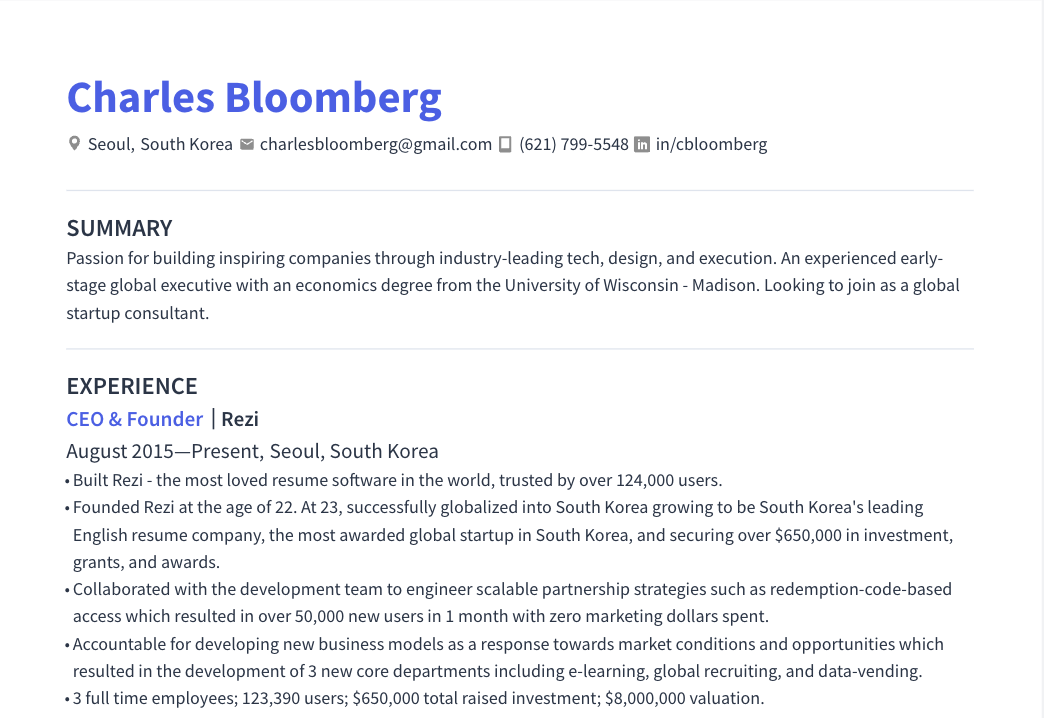
Impress employers and recruiters.
Choose from hundreds of resume examples.
Tailor your resume to this Senior / Staff Software Engineer, ML-based Controls role.
Rezi rewrites your resume against Waabi's job description. Free.
Tailor your resume to this Senior / Staff Software Engineer, ML-based Controls role.
Rezi rewrites your resume against Waabi's job description. Free.
Don't guess if your resume is good enough.
See how it scores against the Senior / Staff Software Engineer, ML-based Controls posting at Waabi — free, in seconds.
Don't guess if your resume is good enough.
See how it scores against the Senior / Staff Software Engineer, ML-based Controls posting at Waabi — free, in seconds.
About the Role
Design and develop data-driven and machine-learned approaches to vehicle control problems, bringing modern ML to a domain traditionally solved with classical methods. Develop learned models of vehicle behavior and dynamics, and integrate them into the closed-loop simulation. Apply machine learning to improve how the controller adapts across vehicles and operating conditions. Be part of a team of multidisciplinary Engineers and Research Scientists using an AI-first approach to enable safe self-driving at scale. Own problems end to end, from conceptualization and offline experimentation through simulation and on-vehicle validation. Build the data pipelines, evaluation metrics, and tooling needed to measure whether a learned approach outperforms the classical baseline. Participate and share ideas in technical and architecture discussions, helping define how learning and classical control coexist in a safety-critical stack.
Responsibilities
- Design and develop data-driven and machine-learned approaches to vehicle control problems.
- Develop learned models of vehicle behavior and dynamics, and integrate them into the closed-loop simulation.
- Apply machine learning to improve controller adaptation across vehicles and operating conditions.
- Own problems end to end, from conceptualization and offline experimentation through simulation and on-vehicle validation.
- Build data pipelines, evaluation metrics, and tooling to measure learned approach performance against classical baselines.
- Participate in technical and architecture discussions to define coexistence of learning and classical control in a safety-critical stack.
Requirements
- MS/PhD or Bachelors degree with a minimum of 4 years of industry experience in Robotics, Controls, Mechanical/Electrical Engineering, Computer Science and/or similar technical field(s) of study.
- Demonstrated depth in control theory and dynamic systems (e.g., MPC, optimal control, state estimation, system identification, kinematic and dynamic vehicle modeling).
- Hands-on experience applying machine learning to a physical system with real hardware in the loop.
- Production-quality coding skill in Python and C++.
- Solid problem solving skills using linear algebra, optimization, statistics & probability.
- Ability to rapidly prototype and test new algorithms.
- Ability to design experiments to prove algorithm effectiveness.
- Open-minded and collaborative team player.
- Willingness to help others.
- Passionate about self-driving technologies, solving hard problems, and creating innovative solutions.
Skills
- Machine Learning
- Python
- C++
- Deep Learning Frameworks (e.g., PyTorch)
- Control Theory
- Dynamic Systems
- Linear Algebra
- Optimization
- Statistics
- Probability
Experience Level
- Minimum of 4 years of industry experience
Education Level
- MS/PhD or Bachelors degree
Salary/Compensations
- $241,000 - $320,000 USD
Benefits
- Competitive perks & benefits
- Equity incentive awards
- Annual performance bonus