Impress employers and recruiters.
Choose from hundreds of resume examples.
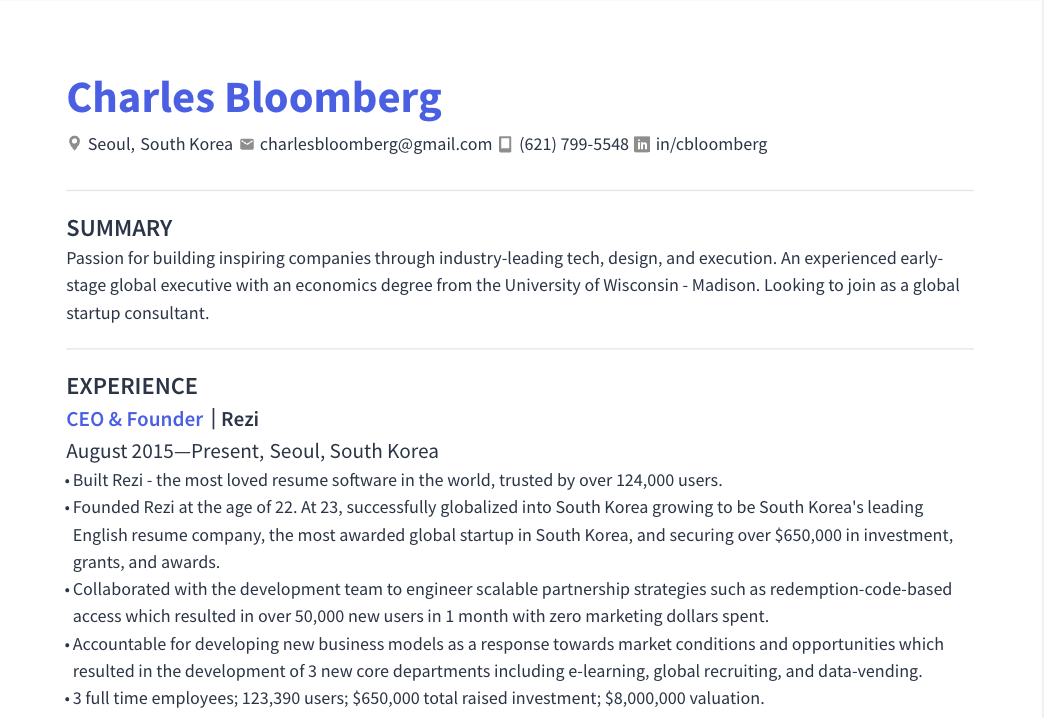
Impress employers and recruiters.
Choose from hundreds of resume examples.
Tailor your resume to this Computational and Experimental Scientist role.
Rezi rewrites your resume against Clera's job description. Free.
Tailor your resume to this Computational and Experimental Scientist role.
Rezi rewrites your resume against Clera's job description. Free.
Don't guess if your resume is good enough.
See how it scores against the Computational and Experimental Scientist posting at Clera — free, in seconds.
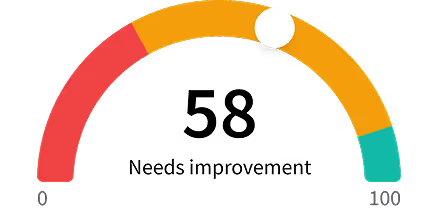
Don't guess if your resume is good enough.
See how it scores against the Computational and Experimental Scientist posting at Clera — free, in seconds.
About the Role
This is a full-stack scientist role at an early-stage AI-driven protein and peptide design company, sitting directly on a lean core team of 5 to 7 and reporting to the CEO. You will own the entire design-make-test-model loop, from sequences out of the inference platform to kinetics data back in, closing that loop end-to-end rather than handing off between functions.
Responsibilities
- Improve and extend pocket-conditioned discrete diffusion models and companion folding models, including refinements, new attention heads, and hierarchical reasoning.
- Operate the AI inference stack at scale and diagnose usage patterns across signups, churn, and customer segments.
- Own fluid-handling robotics and plate automation (Hamilton, Tecan, Opentrons, or equivalent), writing and shipping reliable protocols.
- Own BLI and SPR end-to-end: assay design, immobilization, regeneration, referencing, dilution series, kinetic fitting, QC, and failure-mode diagnosis.
- Write protocols for cloud labs and manage internal screening instrumentation.
- Work the full stack across receptor biology, structure, scoring, and platform output.
- Take sequences from the platform, run kinetics, update models, and ship improved sequences.
Requirements
- 2+ years building or operating discrete diffusion models, protein language models (such as ESM or ProtT5), or structure prediction systems in an active design-make-test cycle, not just academic fine-tuning.
- Personally written and debugged liquid-handler protocols on robotic platforms and shipped them to production.
- Personally fitted BLI or SPR kinetic curves end-to-end and diagnosed failure modes such as mass transport, tip avidity, nonspecific binding, aggregation, or hook effect.
- Fluent with sequence design tools (such as RFdiffusion or BindCraft) as inputs and outputs, not as black boxes.
- Able to explain why a predicted ddG failed on a sensor and trace the root cause.
- Proficient in Python or equivalent scripting for automation and kinetic curve fitting.
- Strong background in biology, biochemistry, or life sciences, with receptor biology and protein structure literacy.
- Operator mentality: resourceful, action-oriented, and comfortable executing under pressure at an early-stage company.
- Background in gene editing, gene therapy, or receptor trafficking is a plus.
- Prior experience at biotech accelerators or as an operator at a biotech startup or exit is a plus.
Skills
- Discrete diffusion models
- Protein language models
- Structure prediction systems
- AI inference stack
- Fluid-handling robotics
- Plate automation
- BLI
- SPR
- Assay design
- Immobilization
- Regeneration
- Referencing
- Dilution series
- Kinetic fitting
- QC
- Failure-mode diagnosis
- Cloud labs
- Screening instrumentation
- Receptor biology
- Protein structure
- Sequence design tools
- Python
- Scripting
- Automation
- Kinetic curve fitting
- Biochemistry
- Life sciences
- Gene editing
- Gene therapy
- Receptor trafficking
Location
- San Francisco, California, US
Work Type
- Hybrid
Experience Level
- 2+ years
Education Level
- Strong background in biology, biochemistry, or life sciences
Salary/Compensations
- $3,000 to $5,000 per month (consulting)
- $80,000 to $200,000 (full-time base salary)
Benefits
- Meaningful equity
- Deal-contingent upside