Impress employers and recruiters.
Choose from hundreds of resume examples.

Impress employers and recruiters.
Choose from hundreds of resume examples.
Tailor your resume to this Neuromorphic/AI Research Scientist role.
Rezi rewrites your resume against Intel Corporation's job description. Free.
Tailor your resume to this Neuromorphic/AI Research Scientist role.
Rezi rewrites your resume against Intel Corporation's job description. Free.
Don't guess if your resume is good enough.
See how it scores against the Neuromorphic/AI Research Scientist posting at Intel Corporation — free, in seconds.
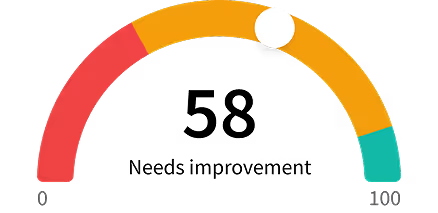
Don't guess if your resume is good enough.
See how it scores against the Neuromorphic/AI Research Scientist posting at Intel Corporation — free, in seconds.
About the Role
Intel's Neuromorphic Computing Lab is seeking a Neuromorphic AI Research Scientist to advance state-of-the-art neuromorphic processor technology toward commercial adoption. This role focuses on modeling, prototyping, and defining architectures and algorithms that enable transformative gains for real-world customer applications in edge computing, signal processing, and autonomous systems.
Responsibilities
- Design and analyze neuromorphic AI algorithms for robotics, signal processing, control, and learning on edge platforms
- Develop research-quality software artifacts including APIs, kernels, and benchmarking tools that enable collaborative innovation
- Prototype and evaluate approaches under realistic constraints including quantization, sparsity, memory footprint, latency, and energy optimization
- Collaborate with hardware and software engineering teams to translate algorithmic requirements into hardware specifications
- Build experimental pipelines and benchmarks for target use cases with comprehensive baseline and ablation studies
- Communicate results through technical documentation, customer prototypes, and publications in leading conferences and journals
- Contribute to technical thought leadership in neuromorphic computing and present findings to internal and external stakeholders
Requirements
- PhD (or equivalent research experience) in Computational Neuroscience, Computer Science, Electrical Engineering, Applied Mathematics, Robotics, or a related field.
- 1+ projects demonstrating the skills to turn research ideas into working prototypes and to evaluate them rigorously (benchmarks, baselines, ablations, quantitative reporting).
- 3+ publications in leading journals or conferences on AI/ML, edge computing, robotics, and/or control.
- 2+ years of experience with state-of-the-art AI models, optimization, and at least one of: control/dynamical systems, signal processing, or probabilistic inference.
- 2+ years of experience with scientific programming for research (e.g., Python or C/C++) including experience with software development best practices (OO design, testing, debugging, documentation, version control, code reviews).
- Track record of open-source releases or widely used internal libraries; skills to write high-impact technical narratives (e.g., position papers).
- 1+ years of experience with a strong mathematical background.
- 1+ years of experience with edge AI HW accelerators or event-based sensors.
- 1+ years of experience with quantization and computations with low-precision arithmetic.
- 1+ years of experience developing software for robotics or other real-time control systems.
- 1+ years of experience building performant components in a systems language (e.g., C/C++/assembler) or equivalent performance-oriented environment.
- 1+ years of experience profiling and benchmarking algorithms and hardware architectures.
- Hardware architecture and design experience.
Skills
- Innovative Problem-Solving
- Collaborative Leadership
- Adaptability
- Communication Excellence
- Results-Oriented Mindset
- Intellectual Curiosity
- Python
- C/C++
- OO design
- testing
- debugging
- documentation
- version control
- code reviews
- Robotics
- Signal Processing
- Control
- Learning on edge platforms
- Quantization
- Sparsity
- Memory footprint optimization
- Latency optimization
- Energy optimization
- AI/ML
- Edge computing
- Probabilistic inference
- Dynamical systems
- Event-based sensors
- Low-precision arithmetic
- Real-time control systems
- Hardware architecture
- Hardware design
Location
- US, California, Santa Clara
- US, Arizona, Phoenix
- US, California, Folsom
- US, Oregon, Hillsboro
- US, Texas, Austin
Work Type
- Hybrid
- Experienced Hire
Experience Level
- 2+ years of experience
- 1+ years of experience
Education Level
- PhD
Salary/Compensations
- $170,500.00-315,490.00 USD
Benefits
- Competitive pay
- Stock bonuses
- Health benefits
- Retirement benefits
- Vacation benefits
About the Company
- Intel's Neuromorphic Computing Lab has been at the forefront of brain-inspired computing for nearly a decade, working alongside a global ecosystem of 250+ research groups.
- Our groundbreaking Loihi series research chips have pioneered event-driven, sparse, and massively parallel neuro-inspired processing, resulting in over 100 peer-reviewed publications.
- As part of Intel's CTO Office, we're now transforming these research breakthroughs into real-world products that will power the next generation of physical AI systems.
- Intel is committed to Responsible Business Alliance (RBA) compliance and ethical hiring practices.
- We do not charge any fees during our hiring process.
- Candidates should never be required to pay recruitment fees, medical examination fees, or any other charges as a condition of employment.
Equal Opportunity
- All qualified applicants will receive consideration for employment without regard to race, color, religion, religious creed, sex, national origin, ancestry, age, physical or mental disability, medical condition, genetic information, military and veteran status, marital status, pregnancy, gender, gender expression, gender identity, sexual orientation, or any other characteristic protected by local law, regulation, or ordinance.