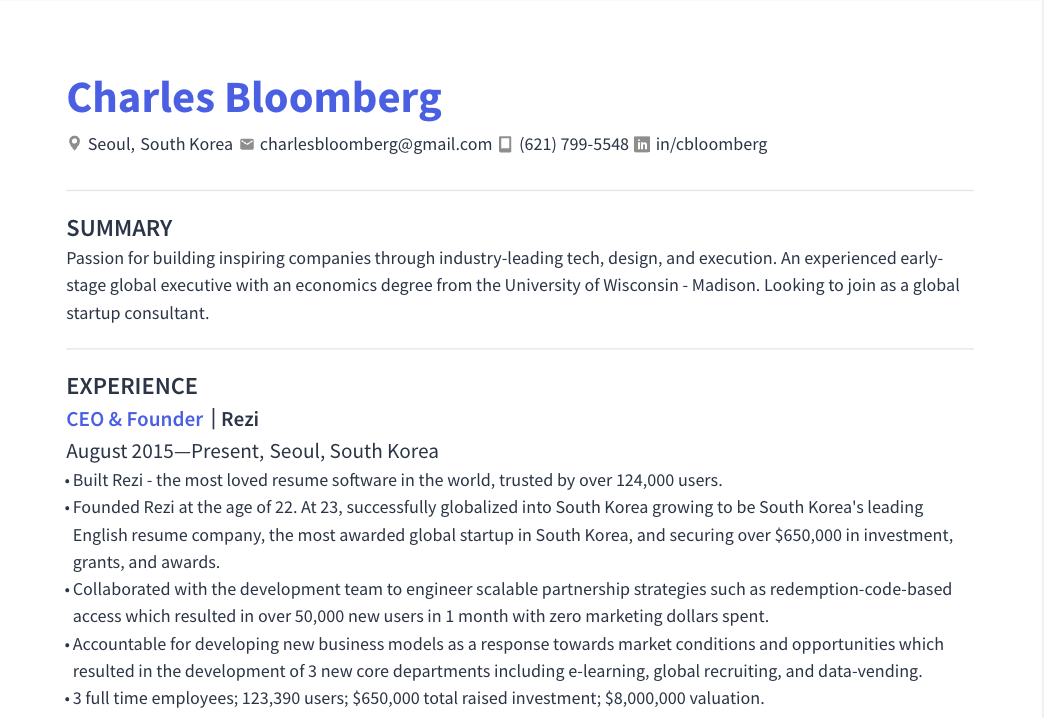
Impress employers and recruiters.
Choose from hundreds of resume examples.
Impress employers and recruiters.
Choose from hundreds of resume examples.
Tailor your resume to this Applications Engineer - Battery Diagnostic Systems role.
Rezi rewrites your resume against Sention Technologies's job description. Free.
Tailor your resume to this Applications Engineer - Battery Diagnostic Systems role.
Rezi rewrites your resume against Sention Technologies's job description. Free.
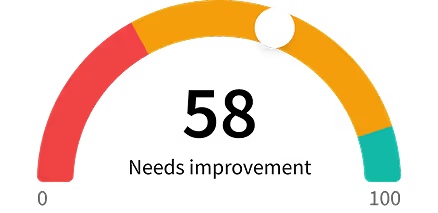
Don't guess if your resume is good enough.
See how it scores against the Applications Engineer - Battery Diagnostic Systems posting at Sention Technologies — free, in seconds.
Don't guess if your resume is good enough.
See how it scores against the Applications Engineer - Battery Diagnostic Systems posting at Sention Technologies — free, in seconds.
About the Role
Build and lead Sention’s applications engineering function while owning the technical customer journey from advanced discovery and demonstrations through deployment, commissioning and long-term adoption of our battery diagnostic systems.
Responsibilities
- Contribute to advanced customer conversations to understand the application, operating environment, decision process, technical constraints and success criteria.
- Translate customer needs into feasible system configurations, test plans, pilot scopes and deployment requirements, while being clear about product limits and technical risk.
- Support the Commercial team with technical input to proposals, tenders, statements of work, timelines and technical negotiations.
- Create simple standard operating procedures (SOPs) and clear handover rules for customer opportunities.
- Plan and lead demonstrations and evaluations of Sention’s hardware and software, tailored to the customer’s use case and audience.
- Present demonstration results to prospective customers.
- Own the technical workstream of customer site pilots from scoping to close-out, and establish reusable preparation, data-capture and reporting practices.
- Lead installation, configuration, commissioning and performance verification for laboratory and manufacturing deployments.
- Integrate and troubleshoot mechanical, electrical, electronic, control and software interfaces.
- Train operators and technical users, document the commissioned configuration and complete a disciplined handover.
- Develop and improve deployment-readiness checks, commissioning records, acceptance criteria and handover templates.
- Act as the primary technical contact for deployed customers, helping them adopt the system, interpret results and obtain continuing value from it.
- Diagnose and resolve complex support issues across hardware, software, data and the customer’s test environment.
- Identify technical risks to satisfaction, renewal or expansion early and provide recommendations to the Commercial team.
- Define and continuously improve the applications engineering operating model.
- Turn field knowledge into reusable discovery SOPs, application notes, demonstration scripts, pilot plans, deployment checks, commissioning checklists, training material, technical reports and troubleshooting playbooks.
- Establish simple metrics that show demonstration quality, pilot progression, deployment time, first-time-right commissioning, customer adoption and recurring support issues.
- Create a disciplined feedback loop that converts field evidence into prioritised product requirements, defect reports and application opportunities.
Requirements
- Around 5–8 years of relevant professional experience, typically combining a substantial period of hands-on engineering with later customer-facing applications engineering, field engineering, systems engineering, technical consultancy or technical sales work.
- A demonstrable record of building, modifying, integrating or commissioning physical systems: instrumentation, sensors, test rigs, industrial equipment, scientific equipment or similarly complex hardware.
- Experience leading technical customer engagements such as discovery, demonstrations, evaluations, pilots, installation, training or post-sale support.
- Sound commercial judgement: able to understand buying processes, negotiate technical scope, maintain momentum and distinguish a valuable customer requirement from an expensive distraction.
- Excellent written, verbal and presentation skills, including the ability to explain uncertain or complex technical findings to engineers, operators, commercial stakeholders and senior decision-makers.
- A record of turning repeated technical work into clear, usable processes, templates or playbooks that improved delivery and were adopted by others.
- Willingness and practical ability to travel regularly within the UK and internationally, sometimes at short notice and with uneven intensity across the year.
- Confident building and adapting fixtures, sensor assemblies, wiring and test setups; comfortable using workshop and laboratory tools safely.
- Competent in low-voltage electronics, sensors, data acquisition and control interfaces; able to read schematics and diagnose systems methodically using appropriate test equipment.
- Comfortable configuring software, examining logs and learning an unfamiliar technical platform.
- Able to design tests, control variables, recognise poor-quality evidence and draw appropriately bounded conclusions from noisy real-world data.
- Hands-on and credible: You enjoy making, testing and fixing things, and build trust with customers’ engineers through practical problem-solving and sound technical judgement.
- Commercially aware: You understand that technical work should lead to customer value and a viable commercial outcome, without overpromising to get there.
- Structured under pressure: You define the problem, protect safety and data quality, communicate clearly and keep ownership until the issue is resolved.
- Autonomous and accountable: You can operate independently at a customer site, make autonomous decisions and escalate before a risk becomes a surprise.
- A pragmatic function builder: You can turn tacit knowledge and ad hoc delivery into simple processes, SOPs and measures that colleagues actually use, without creating bureaucracy for its own sake.
- Collaborative and low-ego: You share field evidence openly, involve the right specialists and care more about the correct answer than whose answer it was.
Skills
- Hardware integration
- Electronics and control engineering
- Software configuration
- Data analysis
- Experimental design
- Technical writing
- Presentation skills
- Process improvement
- Customer support
- Troubleshooting
- Battery sector experience (useful)
- Scientific instrument applications engineering (useful)
- Non-destructive testing (useful)
- Test and measurement (useful)
- Automation (useful)
- Process control equipment (useful)
- Electrochemistry (useful)
- Battery manufacturing (useful)
- Cell quality (useful)
- Acoustic measurement (useful)
- Ultrasonic measurement (useful)
- Signal processing (useful)
- Machine vision (useful)
- Manufacturing line integration (useful)
- PLCs (useful)
- Industrial communications (useful)
- Safety interlocks (useful)
- Quality systems (useful)
- Factory acceptance testing (useful)
- Site acceptance testing (useful)
- Deep-tech start-up experience (useful)
- International customer support (useful)
- Technical selling (useful)
- Customer negotiation (useful)
- Renewals (useful)
- Expansion (useful)
- Channel enablement (useful)
Location
- UK
- International (Europe, North America, Asia)
Work Type
- Full-time
- Onsite (with travel)
Experience Level
- Mid-level (5-8 years)
Education Level
- Degree in electrical, electronic, mechanical, mechatronic, systems or control engineering, physics, or equivalent practical experience.
Salary/Compensations
- £50,000–£60,000
Benefits
- Private health insurance
- Life insurance
- Competitive pension plan with a 5% employer contribution
- 28 days’ annual leave
- UK bank holidays
- One-week Christmas shutdown
About the Company
- Sention Technologies is transforming diagnostics for the electrochemical industry, enabling unprecedented insight into battery performance, quality and safety.
- Our proprietary ultrasound-based technologies allow us to see inside batteries and turn complex measurements into actionable data through our hardware and software platforms.
- By reducing waste, increasing productivity and improving safety, our solutions help R&D teams, battery manufacturers, cell and pack integrators, and fleet operators meet the demands of the energy transition.
- Our ambition is to make advanced battery diagnostics practical from the laboratory to high-volume manufacturing.