Impress employers and recruiters.
Choose from hundreds of resume examples.

Impress employers and recruiters.
Choose from hundreds of resume examples.
Tailor your resume to this Assistant Manager, Controls Framework & RCSA role.
Rezi rewrites your resume against LSEG's job description. Free.
Tailor your resume to this Assistant Manager, Controls Framework & RCSA role.
Rezi rewrites your resume against LSEG's job description. Free.
Don't guess if your resume is good enough.
See how it scores against the Assistant Manager, Controls Framework & RCSA posting at LSEG — free, in seconds.
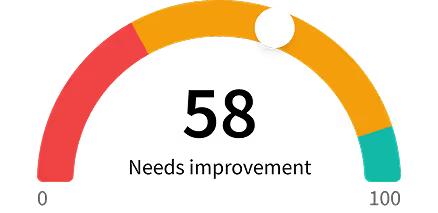
Don't guess if your resume is good enough.
See how it scores against the Assistant Manager, Controls Framework & RCSA posting at LSEG — free, in seconds.
About the Role
FTSE Russell is seeking an experienced, analytical, and controls-focused Senior Associate to support the design, implementation, operation, and continuous improvement of the first-line Controls Framework and Risk & Control Self-Assessment (RCSA) programme across the global business. This role acts as a key subject matter specialist for control management, control quality, control lifecycle discipline, and RCSA execution, supporting the ongoing uplift of FTSE Russell’s controls environment.
Responsibilities
- Support the implementation, operation, and ongoing enhancement of the FTSE Russell Controls Framework.
- Assist with the development and maintenance of control standards, methodologies, guidance, templates, and supporting procedures.
- Promote consistent control documentation and ownership across FTSE Russell, ensuring controls are described clearly, measurably, and testably.
- Support governance activities relating to control design, control lifecycle management, control ownership, and control evidence standards.
- Help ensure controls are aligned to LSEG requirements, FTSE Russell procedures, and applicable regulatory expectations.
- Provide practical support and guidance to control owners and business stakeholders on control documentation, control objectives, frequency, evidence, and ownership.
- Maintain framework documentation and supporting materials, ensuring they remain current, accessible, and aligned to operating model requirements.
- Support the embedding of framework requirements across business areas through workshops, guidance sessions, and stakeholder follow-up.
- Support controls inventory reviews and classification exercises to improve the quality, completeness, and sustainability of the controls population.
- Conduct detailed analysis of control records to identify duplicates, overlaps, obsolete controls, non-control activities, unclear ownership, and inconsistent documentation.
- Assist with control rationalisation and redesign activities, helping to determine which controls should be retained, enhanced, consolidated, or retired.
- Review controls against established standards and challenge deficiencies in control objective, design, execution, evidence requirements, or ownership.
- Support the implementation of improvements to control design, frequency, accountability, evidence standards, and lifecycle governance.
- Track control uplift actions, dependencies, due dates, and remediation progress, escalating delivery risks or unresolved issues where appropriate.
- Support comparison of controls across functions, products, or processes to identify opportunities for standardisation and better alignment.
- Help ensure the control inventory remains accurate, complete, risk-aligned, and capable of supporting assurance, RCSA, and management reporting.
- Support mapping of controls to business processes, process risks, operational risks, and relevant control objectives.
- Assist with the development and maintenance of process, risk, and control inventories, ensuring clear linkage between risk drivers, controls, and outcomes.
- Help ensure controls are aligned to the agreed FTSE Russell risk and process architecture and are positioned at the right point in the process.
- Support integration of control data into RCSA, incident review, issue management, audit response, and root cause analysis activities.
- Identify opportunities to improve risk and control coverage, including areas of duplication, control weakness, under-control, or unclear ownership.
- Work with business and functional stakeholders to clarify process steps, risk points, control activities, and evidence requirements.
- Support the development of a more coherent control lifecycle by linking controls to risks, processes, issues, incidents, assurance outcomes, and remediation activity.
- Coordinate periodic RCSA activities across business functions, supporting planning, preparation, execution, review, and follow-up.
- Facilitate risk and control assessment workshops, helping stakeholders identify key risks, assess control effectiveness, and agree appropriate actions.
- Review RCSA submissions for quality, completeness, consistency, and evidence-based rationale.
- Constructively challenge risk ratings, control effectiveness assessments, action plans, and supporting commentary where information is unclear, inconsistent, or unsupported.
- Monitor completion of RCSA actions and remediation plans, tracking ownership, due dates, dependencies, and delivery status.
- Support the translation of RCSA outcomes into issue creation, control uplift, process improvement, or targeted remediation where required.
- Help ensure RCSA outputs are aligned to underlying incidents, issues, control performance, audit findings, and operational risk themes.
- Support continuous improvement of the RCSA methodology, cadence, templates, guidance, and data quality standards.
- Produce and support controls and RCSA management information for governance forums, working groups, senior management updates, and committee reporting.
- Analyse trends relating to control effectiveness, assessment outcomes, incidents, issues, audit findings, remediation activity, and control inventory quality.
- Support preparation of governance committee and executive reporting, ensuring outputs are accurate, clear, evidence-based, and action-oriented.
- Monitor key performance indicators relating to control framework maturity, control documentation quality, assessment completion, overdue actions, and remediation delivery.
- Identify emerging themes, systemic control weaknesses, or recurring risk drivers and recommend improvement actions.
- Help develop more insight-led reporting that explains what the data means, why it matters, and where management attention is required.
- Ensure reporting outputs are reconciled, timely, and suitable for review by senior stakeholders, second line, Internal Audit, or regulators.
- Support ongoing improvement of reporting definitions, data sources, dashboards, and management information processes.
- Build effective working relationships across Product, Operations, Engineering, Corporate Functions, Risk, Compliance, Internal Audit, and other relevant stakeholders.
- Provide guidance and support to control owners, process owners, and risk coordinators on controls framework requirements and RCSA expectations.
- Facilitate workshops, working groups, and challenge sessions to support control uplift, process-risk-control mapping, and assessment activities.
- Communicate complex risk and control concepts clearly to both specialist and non-specialist audiences.
- Support internal and external reviews, audits, assurance activity, and regulatory enquiries by helping to provide clear, accurate, and well-organised control information.
- Escalate material control gaps, poor-quality documentation, delayed remediation, or unclear ownership in a timely and structured way.
- Act as a reliable point of coordination and subject matter support for controls and RCSA activity within the first line.
- Identify opportunities to improve the effectiveness, efficiency, and consistency of the Controls Framework and RCSA programme.
- Support enhancements within MetricStream and related systems, including improvements to workflow, data quality, reporting, and user experience.
- Promote adoption of controls best practice, governance standards, and evidence-based assessment across FTSE Russell.
- Contribute to the ongoing maturity of the Controls Framework by helping move from inventory maintenance to a more risk-aligned, insight-driven, and assurance-ready control environment.
- Support improvements in control taxonomy, classification, evidence standards, attestation processes, and lifecycle management.
- Help embed a strong controls culture through constructive challenge, transparency, clear ownership, and disciplined follow-through.
- Promote better linkage between controls, RCSA, incidents, issues, audit findings, root cause analysis, and risk appetite monitoring.
Requirements
- Experience in operational risk, controls, audit, governance, compliance, assurance, or a comparable regulated environment.
- Good understanding of risk and control frameworks, including control design, ownership, evidence, testing, effectiveness assessment, and lifecycle management.
- Experience conducting control reviews, control assessments, risk assessments, assurance activity, or quality assurance reviews.
- Strong analytical and problem-solving skills, with the ability to interpret complex information and identify key themes, gaps, and improvement opportunities.
- Ability to assess control documentation and challenge whether controls are clearly defined, measurable, owned, and aligned to risks.
- Experience supporting or facilitating workshops, working groups, or stakeholder review sessions.
- Strong stakeholder management and communication skills, including the ability to influence constructively and explain control concepts clearly.
- Experience producing management information, dashboards, governance reporting, or committee materials.
- Strong organisational skills, with the ability to manage multiple activities, deadlines, and stakeholder follow-ups.
- Excellent attention to detail and a strong focus on data quality, evidence standards, and documentation discipline.
- Ability to work independently, escalate appropriately, and maintain delivery discipline in a complex environment.
- Experience with RCSA methodologies, including risk identification, control assessment, residual risk assessment, and remediation planning.
- Experience using MetricStream or equivalent GRC platforms.
- Understanding of process mapping, risk taxonomy, control design, and controls rationalisation.
- Experience within regulated financial services, market infrastructure, benchmark administration, index, data, or analytics environments.
- Familiarity with issue management, incident management, audit findings, root cause analysis, and remediation tracking.
- Experience supporting regulatory reviews, Internal Audit activity, second-line challenge, or control remediation programmes.
- Professional qualification, or progress toward a qualification, in risk management, audit, governance, compliance, or a related discipline.
Skills
- Controls Framework
- Risk & Control Self-Assessment (RCSA)
- Operational Risk
- Control Design
- Control Ownership
- Control Evidence
- Control Testing
- Effectiveness Assessment
- Lifecycle Management
- Control Reviews
- Risk Assessments
- Assurance Activity
- Quality Assurance
- Analytical Skills
- Problem-Solving
- Stakeholder Management
- Communication Skills
- Influencing
- Workshop Facilitation
- Management Information Production
- Governance Reporting
- Organisational Skills
- Attention to Detail
- Data Quality
- Independent Work
- Escalation
- Delivery Discipline
- Process Mapping
- Risk Taxonomy
- Controls Rationalisation
- Issue Management
- Incident Management
- Audit Findings
- Root Cause Analysis
- Remediation Tracking
- MetricStream
- GRC Platforms
Location
- London
- Hybrid
Work Type
- Full-time
- Hybrid
Experience Level
- Senior Associate
Education Level
- Professional qualification, or progress toward a qualification, in risk management, audit, governance, compliance, or a related discipline.
Benefits
- Healthcare
- Retirement planning
- Paid volunteering days
- Wellbeing initiatives
About the Company
- FTSE Russell operates in a highly regulated, client-critical environment where strong controls, reliable risk assessment, and evidence-based governance are essential.
- London Stock Exchange Group (LSEG) is a leading global financial markets infrastructure and data provider.
- LSEG's purpose is driving financial stability, empowering economies, and enabling customers to create sustainable growth.
- LSEG values include Integrity, Partnership, Excellence, and Change.
- LSEG is a dynamic organisation of 25,000 people across 65 countries.
- LSEG is committed to sustainability across its global business.
- The LSEG Foundation provides charitable grants to community groups that help people access economic opportunities and build a secure future with financial independence.
- Colleagues can get involved through fundraising and volunteering.
Equal Opportunity
- We are proud to be an equal opportunities employer.
- This means that we do not discriminate on the basis of anyone’s race, religion, colour, national origin, gender, sexual orientation, gender identity, gender expression, age, marital status, veteran status, pregnancy or disability, or any other basis protected under applicable law.
- Conforming with applicable law, we can reasonably accommodate applicants' and employees' religious practices and beliefs, as well as mental health or physical disability needs.