Student Research Assistants Medical Sensing, Communications, and Modeling
Fraunhofer-Gesellschaft · BE, DE
12 days agoImpress employers and recruiters.
Choose from hundreds of resume examples.

Impress employers and recruiters.
Choose from hundreds of resume examples.
Tailor your resume to this Student Research Assistants Medical Sensing, Communications, and Modeling role.
Rezi rewrites your resume against Fraunhofer-Gesellschaft's job description. Free.
Tailor your resume to this Student Research Assistants Medical Sensing, Communications, and Modeling role.
Rezi rewrites your resume against Fraunhofer-Gesellschaft's job description. Free.
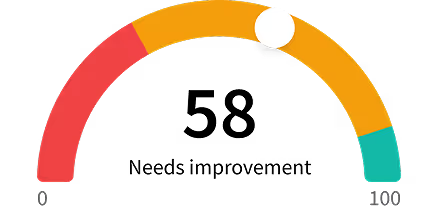
Don't guess if your resume is good enough.
See how it scores against the Student Research Assistants Medical Sensing, Communications, and Modeling posting at Fraunhofer-Gesellschaft — free, in seconds.
Don't guess if your resume is good enough.
See how it scores against the Student Research Assistants Medical Sensing, Communications, and Modeling posting at Fraunhofer-Gesellschaft — free, in seconds.
About the Role
The "Wireless Communications and Networks" department at Fraunhofer Heinrich Hertz Institute (HHI) develops wireless communication systems for future mobile network generations (5G+/6G and beyond). The "Connected Intelligence and Robotics" (CIR) group focuses on advanced radio systems, AI-native communications, integrated sensing and communication (ISAC), edge intelligence, digital twins, and secure wireless connectivity. In close collaboration with medical partners, the group investigates how emerging 6G technologies can enable future healthcare applications, including novel approaches for medical sensing, physiological monitoring, diagnostics, therapy support, and telemedicine, validated through simulations and experimental testbeds.
Responsibilities
- Develop and evaluate algorithms for acquiring, processing, and analyzing physiological signals and vital parameters.
- Apply and advance methods in digital signal processing, statistical data analysis, and artificial intelligence for medical sensing systems.
- Model, simulate, and analyze biophysical processes and medical sensing and communication systems.
- Develop novel approaches for contactless and multimodal vital sign monitoring and interpretation of medical measurement data.
- Contribute to solving inverse problems and reconstructing physiological states from sensor data.
- Design, integrate, and validate hardware-oriented demonstrators, measurement systems, and experimental test platforms.
- Plan, execute, and evaluate experiments, measurement campaigns, and simulation studies in digital health technologies.
- Develop software tools and data analysis workflows for innovative medical sensing, communication, and assistive systems.
Requirements
- Experience in developing and evaluating algorithms for physiological signal processing.
- Proficiency in digital signal processing, statistical data analysis, and artificial intelligence.
- Experience with modeling, simulation, and analysis of biophysical processes.
- Knowledge of contactless and multimodal vital sign monitoring.
- Ability to solve inverse problems and reconstruct physiological states.
- Experience in designing and validating hardware demonstrators and measurement systems.
- Skills in planning and executing experiments and measurement campaigns.
- Experience in developing software tools and data analysis workflows.
Skills
- Algorithm development
- Physiological signal processing
- Digital signal processing
- Statistical data analysis
- Artificial intelligence
- Medical sensing systems
- Biophysical process modeling
- System simulation
- Contactless monitoring
- Multimodal monitoring
- Inverse problem solving
- Hardware integration
- Experimental validation
- Software development
- Data analysis workflows
About the Company
- The "Wireless Communications and Networks" department at Fraunhofer Heinrich Hertz Institute (HHI) develops wireless communication systems for future mobile network generations (5G+/6G and beyond).
- The "Connected Intelligence and Robotics" (CIR) group focuses on advanced radio systems, AI-native communications, integrated sensing and communication (ISAC), edge intelligence, digital twins, and secure wireless connectivity.