Impress employers and recruiters.
Choose from hundreds of resume examples.

Impress employers and recruiters.
Choose from hundreds of resume examples.
Tailor your resume to this Copy of Lead Inertial Sensor Engineer - MEMS role.
Rezi rewrites your resume against Advanced Navigation's job description. Free.
Tailor your resume to this Copy of Lead Inertial Sensor Engineer - MEMS role.
Rezi rewrites your resume against Advanced Navigation's job description. Free.
Don't guess if your resume is good enough.
See how it scores against the Copy of Lead Inertial Sensor Engineer - MEMS posting at Advanced Navigation — free, in seconds.
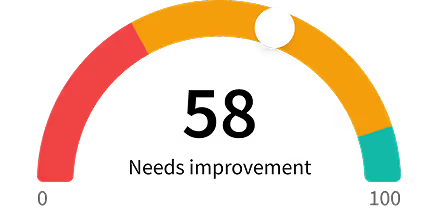
Don't guess if your resume is good enough.
See how it scores against the Copy of Lead Inertial Sensor Engineer - MEMS posting at Advanced Navigation — free, in seconds.
About the Role
In this role, you will be a subject matter expert, filling a critical knowledge gap in your engineering team. Given that our company heavily relies on software to enhance hardware performance, this person must have a strong multidisciplinary background across physics, electronics, and software. The ideal candidate would have a unique blend of hands-on testing experience and a deep theoretical understanding of sensor technologies. Your background should bridge the gap between our software, mechanical, and electronic engineering teams.
Responsibilities
- Contribute to the research and development of novel, internally-developed sensor technologies.
- Provide expert guidance to the engineering team on the critical properties of sensors for inertial navigation systems.
- Develop and implement advanced sensor calibration techniques to optimise system performance.
- Lead the testing, characterisation, and selection of third-party inertial sensors.
- Analyse test data to identify sensor performance limitations and areas for improvement.
- Collaborate with cross-functional teams to integrate sensors into our diverse product range, from low-cost to high-end systems.
Requirements
- A degree in a relevant field such as Physics, Mechatronics, Electrical Engineering, or a closely related discipline is essential.
- An advanced degree (Master's or PhD) would be highly advantageous, especially if their research was focused on sensor technology or inertial navigation.
- Proven experience in designing and executing tests for inertial sensors (accelerometers and gyroscopes).
- Understanding of test methodologies, sources of error, and how to analyse the resulting data.
- Experience in the development of new sensors is crucial.
- A deep understanding of how sensor characteristics impact the performance of an Inertial Navigation System (INS) is paramount.
- Proficiency in advanced sensor calibration methods to minimise errors and optimise performance.
- Proficiency in software tools used for data acquisition and analysis, such as Python or MATLAB, is important.
- Experience in one of our key industries—like defense, maritime, or autonomous vehicles—would be a significant plus.
Skills
- Sensor technologies
- Multidisciplinary background (physics, electronics, software)
- Hands-on testing
- Theoretical understanding
- Inertial navigation systems
- Sensor calibration techniques
- Sensor testing and characterisation
- MEMS
- FOG
- Software and data analysis
- Python
- MATLAB
Education Level
- Degree in Physics, Mechatronics, Electrical Engineering, or related discipline
- Master's or PhD (highly advantageous)