Impress employers and recruiters.
Choose from hundreds of resume examples.
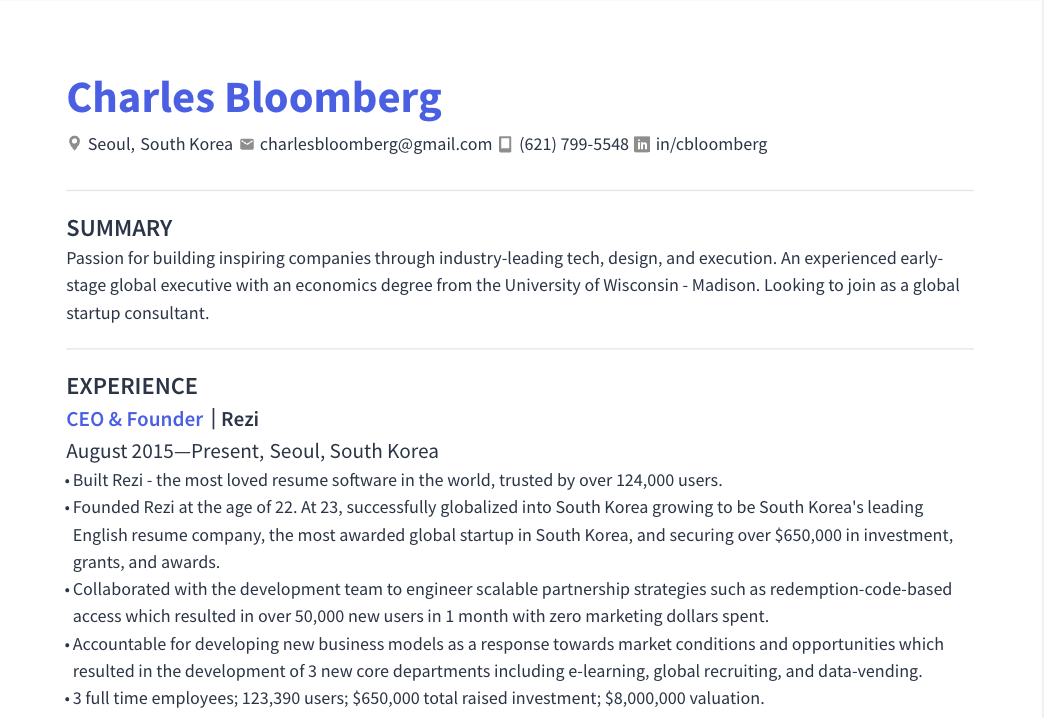
Impress employers and recruiters.
Choose from hundreds of resume examples.
Tailor your resume to this Expert(e) en science des données role.
Rezi rewrites your resume against OECD's job description. Free.
Tailor your resume to this Expert(e) en science des données role.
Rezi rewrites your resume against OECD's job description. Free.
Don't guess if your resume is good enough.
See how it scores against the Expert(e) en science des données posting at OECD — free, in seconds.
Don't guess if your resume is good enough.
See how it scores against the Expert(e) en science des données posting at OECD — free, in seconds.
About the Role
The OECD WISE Unit is seeking a Data and Knowledge Scientist to contribute to its work on benchmarking societal progress in OECD member countries beyond traditional macroeconomic indicators. This role will focus on the OECD Better Life Initiative, flagship reports, and related country and thematic studies. The successful candidate will work under the guidance of the Head of the Data Development and Application Unit and contribute to the broader work of the WISE Centre.
Responsibilities
- Develop, build, and maintain automated data pipelines (back-end and front-end) to support the Better Life database on the OECD Data Explorer, ensuring robust quality assurance processes.
- Manage regular updates (at least quarterly) of the Better Life database and the Better Life Index.
- Coordinate data collection for the Committee on Statistics and Data and Information Management, including drafting requests and collaborating with national statistical offices.
- Stay informed about new tools and methods in data science and AI, evaluating their applicability to data infrastructure, visualization, and analysis on well-being.
- Maintain and further develop the OECD Well-being Data Explorer, the WISE Centre's interactive well-being data portal, including front-end development, back-end integration, and alignment with OECD web architecture.
- Create compelling and accessible data visualizations to enhance the visibility and adoption of WISE Centre products among policymakers and stakeholders, ensuring scalability of knowledge-based products.
- Collaborate closely with the WISE Centre communication team and other OECD communication units as needed.
- Engage with relevant communities of practice within the OECD data science network to pool expertise and foster innovation.
- Provide training and technical advice to the WISE team on best practices in data science, automation, and data visualization.
- Conduct analyses and draft content for WISE statistical and policy-oriented publications on well-being, including the flagship Better Life report, country-specific well-being studies, and thematic reports.
- Analyze well-being outcomes using statistical techniques, including econometric modelling and micro-data analysis, in economic, social, and environmental domains.
- Identify trends requiring policy attention within the context of rapid economic, environmental, digital, and demographic transitions.
- Present findings and policy implications to internal and external stakeholders, such as national administrations and international partners.
- Under the guidance of the Head of Unit, oversee the process of analysis, drafting, and publication of WISE knowledge-based products.
Requirements
- University degree at a higher level in economics, statistics, data science, or a related discipline with a strong quantitative component.
- At least four years of relevant experience in applied public policy research and/or data science.
- Experience with econometric analysis and the use of micro-data.
- Proven experience in developing and maintaining scalable data infrastructures and automated workflows.
- Proven expertise in well-being-related fields is desirable.
- Excellent command of R (preferred) or comparable statistical programming languages.
- Experience with version control systems (e.g., Git).
- Knowledge of web development tools (e.g., JavaScript) and data visualization tools.
- Knowledge of AI-assisted data analysis and automation tools, or an interest in them (e.g., using large language models for code development, data cleaning, or writing assistance).
- Excellent writing skills in English, with proven experience in applied public policy research.
- Willingness to embrace new technologies and working methods, including AI-based tools, to enhance productivity and analytical rigor.
- OECD staff are expected to demonstrate behaviour consistent with the six key competencies: Vision and Strategy (Level 1); Developing People (Level 1); Ethics and Integrity (Level 1); Collaboration and Horizontality (Level 2); Delivering Results (Level 1); Innovation and Acceptance of Change (Level 1).
- Full proficiency in one of the OECD's two official languages (English and French) and knowledge of the other, or willingness to learn.
Skills
- Data Science
- Knowledge Management
- Data Pipelines
- Data Quality Assurance
- Database Management
- Statistical Analysis
- Econometric Modelling
- Micro-data Analysis
- Data Visualization
- AI Tools
- R
- Git
- JavaScript
- Public Policy Research
- Communication
Location
- Paris, France
Work Type
- Full-time
- Permanent contract
Experience Level
- At least four years of relevant experience
Education Level
- University degree at a higher level in economics, statistics, data science, or a related discipline with a strong quantitative component.
Salary/Compensations
- Monthly base salary starting from 6,008.38 EUR
Benefits
- Tax-free income in France
- Allowances/indemnities based on personal situation
- Access to OECD Staff Regulations and Rules
- Access to OECD Staff Manual
- Potential for engagement under new contractual terms (for appointments from July 1, 2025)
About the Company
- The Organisation for Economic Co-operation and Development (OECD) is an international organisation of 38 member countries working to build better policies for better lives.
- Its mission is to promote policies that will improve the economic and social well-being of people around the world.
- The OECD Centre for Well-being, Inclusion, Sustainability and Equal Opportunity (WISE) produces new data and defines new approaches to improve people's well-being and reduce inequalities.
- The Data Development and Application Unit within WISE has extensive experience in conceptualising and measuring well-being, based on the OECD's innovative well-being measurement framework.
Equal Opportunity
- As part of its equal opportunity policy, the OECD encourages applications from all qualified nationals of its member countries, regardless of their ethnic or racial origin, opinions or beliefs, gender, sexual orientation, health status, or any disability.
- The OECD promotes the optimal use of its resources internally to improve its efficiency and effectiveness, and staff members are encouraged to contribute actively to achieving this goal.