Impress employers and recruiters.
Choose from hundreds of resume examples.
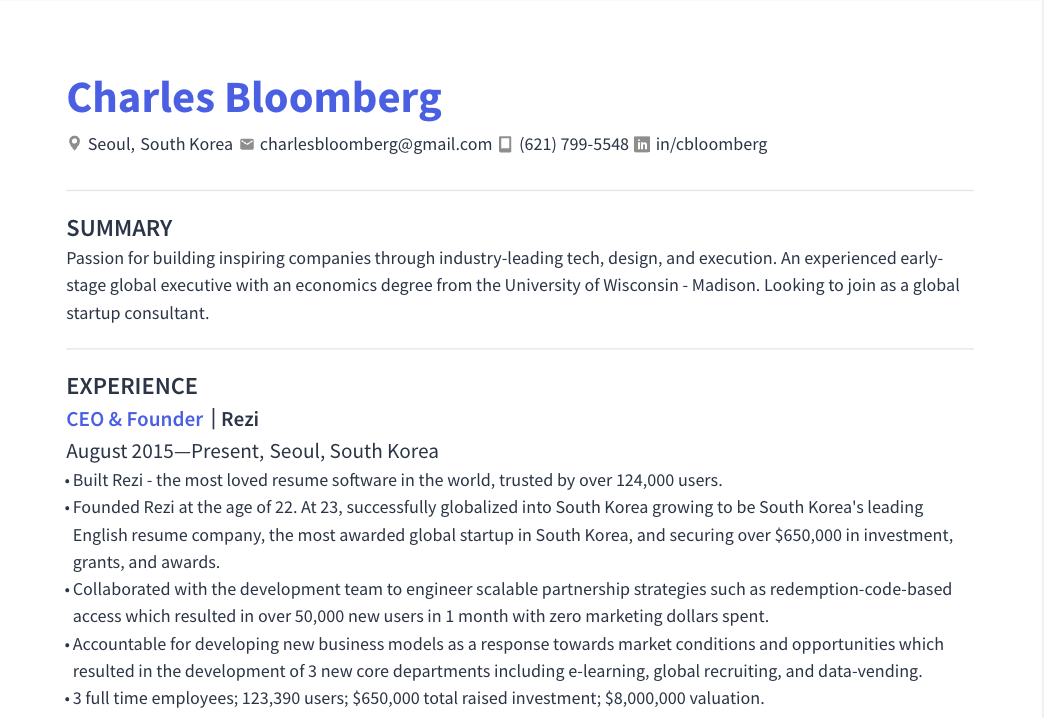
Impress employers and recruiters.
Choose from hundreds of resume examples.
Tailor your resume to this Senior Computational Biologist role.
Rezi rewrites your resume against Garvan Institute of Medical Research's job description. Free.
Tailor your resume to this Senior Computational Biologist role.
Rezi rewrites your resume against Garvan Institute of Medical Research's job description. Free.
Don't guess if your resume is good enough.
See how it scores against the Senior Computational Biologist posting at Garvan Institute of Medical Research — free, in seconds.
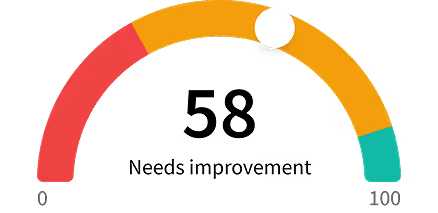
Don't guess if your resume is good enough.
See how it scores against the Senior Computational Biologist posting at Garvan Institute of Medical Research — free, in seconds.
About the Role
The Cancer Plasticity and Dormancy Program aims to discover fundamental mechanisms regulating cancer cell dormancy and relapse, developing tools for prediction and treatment. The AllClear program, a major collaborative initiative supported by the National Breast Cancer Foundation, focuses on breast cancer relapse, integrating expertise from biology, immunology, oncology, mathematics, computational biology, and machine learning.
Responsibilities
- Lead a defined program of computational and machine learning research within the AllClear initiative.
- Independently design, lead, and drive complex machine learning and computational biology projects.
- Set and manage progress towards program goals.
- Serve as the senior computational advisor for the Chaffer/Croucher laboratories and the wider AllClear consortium.
- Drive the discovery of dormant cancer cells and their regulatory molecular programs through state-of-the-art machine learning pipelines.
- Coordinate collaborative approaches with international partners.
- Supervise and mentor junior computational staff.
- Hold significant leadership roles in project execution, methodology development, and grant funding.
- Independently determine computational, mathematical, and statistical methods for AllClear research.
- Contribute to the design and development of novel deep learning approaches for large-scale, multi-omic analysis of dormant cancer cells.
- Apply established tools from the lab, including developing foundation models for relapse prediction and single-cell trajectory inference.
- Integrate multi-omic, imaging, and clinical data.
- Lead a computational biology body of work based on machine learning to advance the discovery of dormant cancer cells and their regulatory molecular programs.
- Take a strategic view of the AllClear computational body of work, prioritizing and planning research direction.
- Establish a profile in computational biology and machine learning for cancer research.
- Serve as a first-line contact for computational work between the laboratory, AllClear program investigators, project managers, and international collaborators.
- Coordinate methodology development and large-scale analyses with internal and external partners.
- Act as a principal supervisor or co-supervisor for computational research students, junior computational scientists, and other team members.
- Delegate tasks and provide technical guidance on complex problems.
- Advise and coach lab members to develop their scientific, technical, statistical, and research management skills.
- Manage own continuing development, tracking advancements in deep learning, single-cell analysis, and manifold learning methods.
- Participate in employee development and mentoring programs.
- Act as a named Investigator or Co-Investigator on external research grant submissions.
- Contribute substantially to the computational sections of team grants and fellowships.
- Work towards securing independent or co-investigator funding.
- Take responsibility for the efficient day-to-day operation of the AllClear computational infrastructure.
- Manage data-production and analysis pipelines.
- Ensure reproducibility of computational analyses.
- Establish best practices for computational analysis.
- Contribute to data-access governance for AllClear data.
- Ensure all computational research conforms to good scientific practice, data-security requirements, and open-science standards.
- Participate in institute committees, training programs, and fundraising events.
- Contribute to the institute's data science and machine learning community.
- Actively participate in relevant scientific societies.
- Act as a peer reviewer for grants, manuscripts, and machine learning conferences.
- Engage in the communication of science to the public.
- Translate machine learning approaches for lay audiences.
- Participate in media interviews, public seminars, and patient advocacy engagement.
Requirements
- A PhD in computational biology, bioinformatics, machine learning, applied mathematics, statistics, computer science, or a closely related quantitative discipline.
- 5+ years of relevant postdoctoral or equivalent experience.
- Demonstrated track record of designing, leading, and delivering complex computational projects independently.
- Proven ability to manage multiple simultaneous long-term computational projects.
- Ability to translate high-level scientific goals into concrete computational approaches.
- Ability to coordinate collaborative analyses across institutions.
- Highly developed written and verbal communication skills for methodological and biological publications, grant writing, and presentations.
- Advanced expertise in machine learning and artificial intelligence, including deep learning frameworks.
- Expertise in scientific programming (Python, R).
- Expertise in high-performance and cloud computing.
- Expertise in single-cell analysis toolkits and their application to single-cell multi-omic datasets.
- Familiarity with foundation models for biomedical data and integration of imaging, molecular, and clinical modalities is highly desirable.
- Excellent ability to build and maintain internal and external working relationships with a wide range of stakeholders.
- Only applicants with full working rights in Australia are eligible to apply.
Skills
- Machine learning
- Computational biology
- Deep learning
- Scientific programming (Python, R)
- High-performance computing
- Cloud computing
- Single-cell analysis
- Multi-omic data analysis
- Foundation models for biomedical data
- Integration of imaging, molecular, and clinical data
- Project management
- Collaboration
- Supervision
- Mentoring
- Grant writing
- Data governance
- Data security
- Open science standards
Location
- Australia
Work Type
- 2 year term contract
- Full-time
Experience Level
- Senior
- 5+ years postdoctoral or equivalent experience
Education Level
- PhD
Salary/Compensations
- Up to $140,400 + 14% super + salary packaging
Benefits
- Generous salary packaging (max. $15,900 general expenses + $2,650 meals/accom)
- Ample opportunities for on-going training and development
- Stimulating, diverse and highly international research environment
- Flexible work arrangements (e.g., start/finish times)
- 18 weeks paid parental leave for both parents including paid superannuation
- A range of additional leave types (cultural leave, conference leave, community service, study leave)
- Discounted Health Insurance
- Lifestyle discounts with community partners
About the Company
- The Cancer Plasticity and Dormancy Program is focused on discovering the fundamental control mechanisms that regulate cancer cell dormancy and cancer relapse.
- Our goal is to develop tools to predict relapse and develop new treatments to stop relapse before it occurs.
- There is a focus on understanding relapse in cancers that spread to the skeleton including, multiple myeloma, breast and prostate cancer.
- The program has recently established the AllClear program, supported by a major collaborative research accelerator grant from the National Breast Cancer Foundation, to tackle cancer relapse in breast cancer.
- This is a major national and international collaborative program and flagship activity for the program.
- AllClear brings together interdisciplinary expertise in cancer biology, bone biology, immunology, clinical oncology, mathematics, computational biology and machine learning to dissect the cellular and molecular programs that drive cancer relapse.
Equal Opportunity
- Only applicants with full working rights in Australia are eligible to apply for this role.