Impress employers and recruiters.
Choose from hundreds of resume examples.
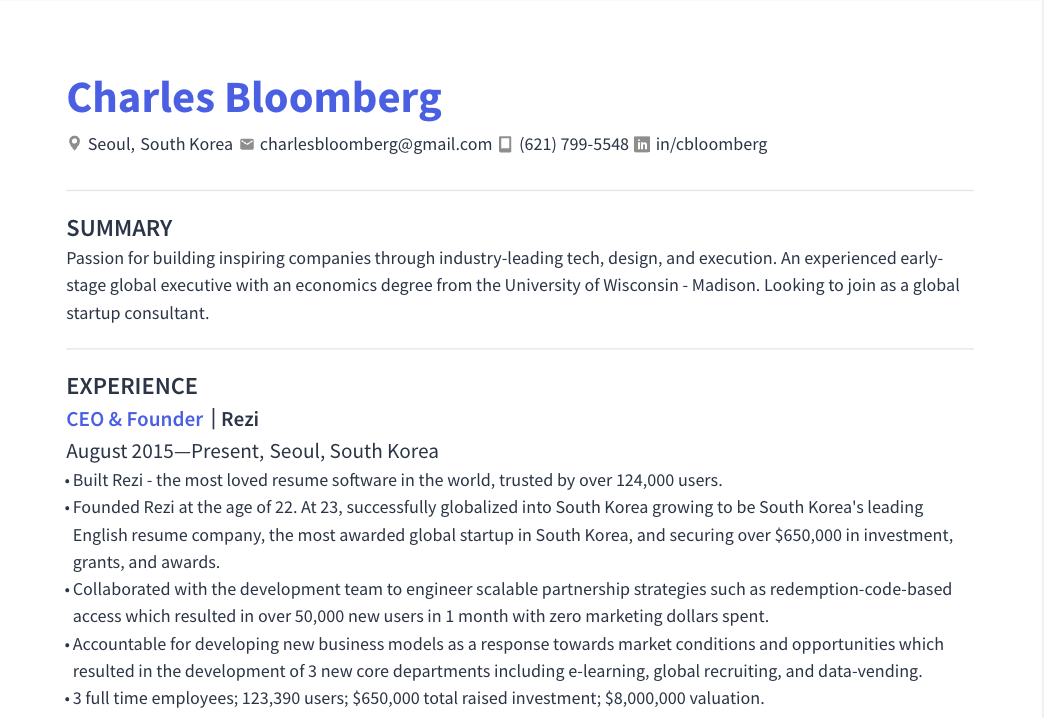
Impress employers and recruiters.
Choose from hundreds of resume examples.
Tailor your resume to this Scientist/Sr. Scientist, Computational Chemistry role.
Rezi rewrites your resume against General Proximity's job description. Free.
Tailor your resume to this Scientist/Sr. Scientist, Computational Chemistry role.
Rezi rewrites your resume against General Proximity's job description. Free.
Don't guess if your resume is good enough.
See how it scores against the Scientist/Sr. Scientist, Computational Chemistry posting at General Proximity — free, in seconds.
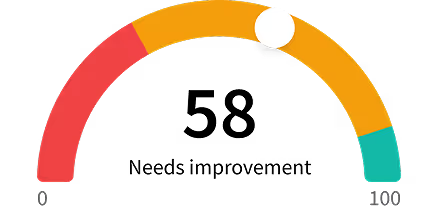
Don't guess if your resume is good enough.
See how it scores against the Scientist/Sr. Scientist, Computational Chemistry posting at General Proximity — free, in seconds.
About the Role
General Proximity is seeking a first-rate computational chemist to pioneer the uncharted frontier of induced proximity medicines (IPMs). This role will support computational chemistry, cheminformatics, and molecular design efforts, driving small-molecule drug discovery programs.
Responsibilities
- Provide hands-on computational chemistry support to small-molecule discovery programs from target evaluation, hit identification, hit-to-lead, and lead optimization through candidate nomination.
- Apply structure-based and ligand-based design approaches to guide compound design, including docking, molecular dynamics, pharmacophore modeling, QSAR, scaffold hopping, virtual screening, FEP/free-energy methods, and multi-parameter optimization.
- Use structural biology data, including X-ray structures, cryo-EM structures, homology models, and AlphaFold-derived models, to generate actionable design hypotheses.
- Partner with the medicinal chemistry team to interpret SAR, optimize potency, selectivity, physicochemical properties, ADME/PK, developability, and synthetic feasibility.
- Contribute to computational design discussions with project teams and translate complex modeling results into clear, practical medicinal chemistry recommendations.
- Support portfolio prioritization by evaluating target tractability, ligandability, binding-site quality, chemical matter, and developability risks.
- Use and help improve chem and bioinformatics tools that support compound registration, structure-searching, SAR analysis, property visualization, compound triage, library design, and project decision-making.
- Apply tools for chemical data handling, including similarity and substructure searching, R-group analysis, matched molecular pairs, reaction enumeration, compound clustering, property prediction, and visualization.
- Work with internal or external engineering and data science teams to integrate chemical, biological, DMPK, structural, and assay data into usable project dashboards and design tools.
- Follow best practices for chemical data quality, assay data curation, compound annotation, metadata standards, and reproducible computational workflows.
- Use commercial and open-source computational tools, including platforms such as Schrödinger, MOE, CCDC tools, ChemAxon, KNIME, Pipeline Pilot, RDKit, DataWarrior, Spotfire, and related systems.
- Apply user-friendly AI/ML-enabled molecular design tools, including generative chemistry, predictive ADME/Tox models, property prediction, active learning, virtual screening, and decision-support systems.
- Help incorporate AI tools into the DMTA cycle, including compound prioritization, library design, synthetic route ideation, molecular-property prediction, and design hypothesis generation.
- Support AI literacy across chemistry and project teams by helping colleagues understand appropriate use, limitations, and interpretation of predictive models.
- Help develop workflows that allow medicinal chemists to use modeling and AI tools without requiring deep computational expertise.
- Contribute to the computational chemistry approach for projects and align it with discovery program needs.
- Serve as a subject-matter resource for computational chemistry, cheminformatics, AI-enabled design, and molecular modeling.
- Support collaborations with CROs, software vendors, academic groups, and computational chemistry consultants where appropriate.
- Represent computational chemistry in project team meetings and program discussions.
- Maintain awareness of emerging computational, AI, and cheminformatics technologies and recommend adoption where scientifically and operationally justified.
Requirements
- PhD in Computational Chemistry, Medicinal Chemistry, Chemical Physics, Biophysics, Cheminformatics, Physical Organic Chemistry, or a related discipline.
- A minimum of 3 years of relevant experience in pharma, biotech, or a drug discovery-focused research environment.
- Track record of using computational chemistry to impact small-molecule drug discovery programs, ideally through hit-to-lead or lead optimization.
- Hands-on expertise in structure-based drug design, ligand-based design, docking, molecular dynamics, virtual screening, QSAR, FEP/free-energy methods, pharmacophore modeling, and multi-parameter optimization.
- Strong working knowledge of medicinal chemistry principles, SAR interpretation, physicochemical property optimization, ADME/PK concepts, and developability considerations.
- Practical experience with cheminformatics platforms, chemical databases, chemical data curation, compound registration systems, and project-facing visualization tools.
- Experience with AI/ML applications in molecular design, including predictive modeling, generative chemistry, active learning, or AI-enabled compound prioritization.
- Strong programming or scripting ability, preferably Python, with experience using cheminformatics toolkits such as RDKit and modern data science workflows.
- Ability to communicate complex computational concepts clearly to medicinal chemists, biologists, and non-specialist stakeholders.
- Ability to collaborate within cross-functional teams and influence project decisions through strong scientific input.
- Experience working in a biotech or fast-moving discovery organization.
- Experience implementing user-friendly modeling tools for medicinal chemists.
- Familiarity with cloud-based or high-performance computing environments.
- Experience with automated DMTA workflows, electronic lab notebooks, compound management systems, assay-data systems, and integrated discovery platforms.
- Experience supporting discovery across multiple modalities, such as covalent inhibitors, bifunctional molecules, and molecular glues.
- Familiarity with synthetic accessibility prediction, retrosynthesis tools, reaction enumeration, and library design.
- Scientific contributions through publications, presentations, patents, open-source contributions, or demonstrated project impact.
Skills
- Computational Chemistry
- Cheminformatics
- Molecular Design
- Structure-based drug design
- Ligand-based design
- Docking
- Molecular dynamics
- Virtual screening
- QSAR
- FEP/free-energy methods
- Pharmacophore modeling
- Multi-parameter optimization
- Medicinal chemistry principles
- SAR interpretation
- Physicochemical property optimization
- ADME/PK concepts
- Developability considerations
- AI/ML applications in molecular design
- Predictive modeling
- Generative chemistry
- Active learning
- AI-enabled compound prioritization
- Python programming
- RDKit
- Data science workflows
- Communication
- Collaboration
- Cloud computing
- High-performance computing
- Automated DMTA workflows
- Electronic lab notebooks
- Compound management systems
- Assay-data systems
- Integrated discovery platforms
- Covalent inhibitors
- Bifunctional molecules
- Molecular glues
- Synthetic accessibility prediction
- Retrosynthesis tools
- Reaction enumeration
- Library design
Location
- MBC BioLabs at 135 Mississippi Street
Work Type
- Full-time
Experience Level
- Minimum of 3 years of relevant experience
- PhD
Education Level
- PhD in Computational Chemistry, Medicinal Chemistry, Chemical Physics, Biophysics, Cheminformatics, Physical Organic Chemistry, or a related discipline.
Benefits
- Strong equity incentives
- Top tier medical, dental, and vision coverage + One Medical membership
- 401(k) retirement plans
- Education and health/fitness incentive programs
- Meditation retreats—do a ten-day Vipassana retreat without counting towards vacation days.
- Reading budget
About the Company
- General Proximity is a seed-stage startup developing the next generation of induced proximity medicines (IPMs).
- Our OmniTAC drug discovery engine furnishes molecules that co-opt existing cellular machinery to overcome therapeutic challenges, which have remained unapproachable to other modalities for decades.
- We believe time is our most valuable commodity, so we strive to create a culture that reflects this.
- We won’t drag you through unnecessary meetings or email you at 7 PM on a Saturday.
- When we're at work, we're there to get things done, and when we're off, we're really off.
- We like well-written documents over PowerPoints, OKRs over vague mission statements, and weekly one-on-ones over yearly reviews.
- We have a "writing-first" culture. We believe that clarity of writing reflects clarity of thinking and that the benefits of well-written documentation in a scientific environment are innumerable: democratization of ideation and decision-making, increased reproducibility, quicker scaling and onboarding, and better company-wide alignment, to name a few.
- As an early-stage startup, we value scientists with an independent, can-do attitude.
- The more hats you can wear, the better.
- Our job as employers is to put you in positive feedback loops so you can grow in the direction of your choosing.
Equal Opportunity
- Applications from candidates of diverse backgrounds, women, and members of underrepresented minority groups are particularly welcomed.