Impress employers and recruiters.
Choose from hundreds of resume examples.
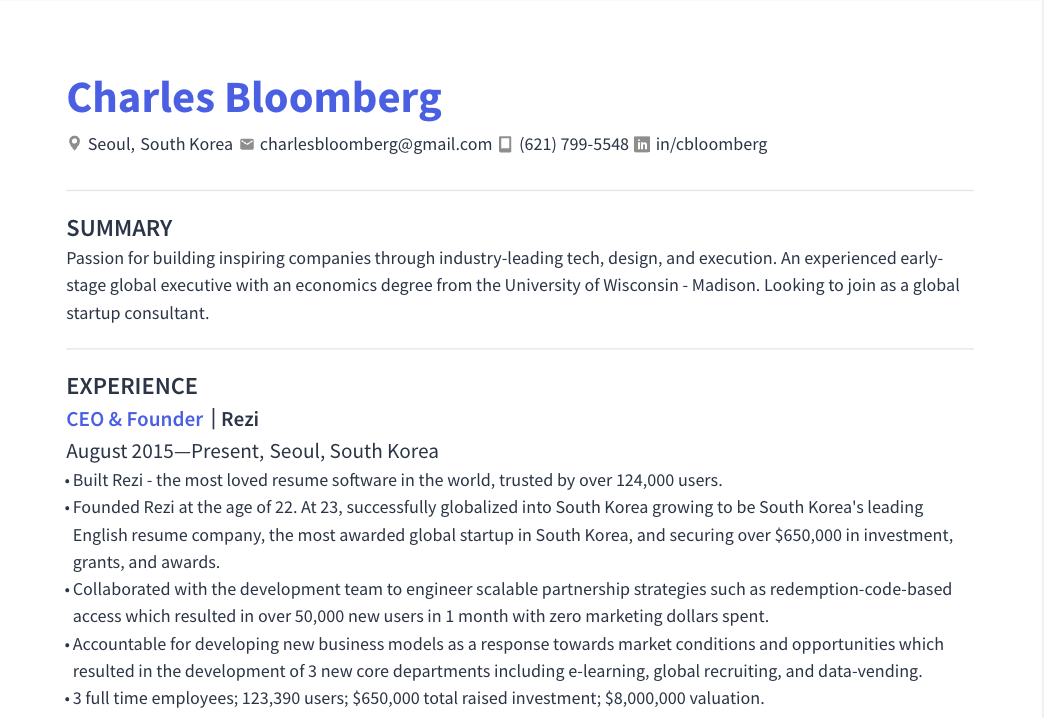
Impress employers and recruiters.
Choose from hundreds of resume examples.
Target Resume Now
About the Role
Develop advanced machine-learning systems for understanding and predicting protein structure, working at the intersection of large-scale biological models, geometric deep learning, and structural biology. This hands-on research and engineering role involves model development, training, evaluation, and scientific analysis with an emphasis on building systems that generalize beyond standard benchmarks.
Responsibilities
- Develop and improve machine-learning models for protein structure prediction and related structural biology tasks.
- Train and fine-tune protein language models, geometric neural networks, diffusion models, and other modern scientific machine-learning architectures.
- Explore new architectures and learning objectives for modeling protein sequence and structure.
- Build reliable data pipelines and evaluation systems for structural modeling.
- Design rigorous benchmarks that measure generalization and minimize data leakage or memorization.
- Evaluate models using established structural accuracy, confidence, and physical-validity metrics.
- Analyze model performance across diverse proteins, structural classes, and biological contexts.
- Run ablation studies and controlled experiments to understand the impact of model architecture, data, scale, and training methodology.
- Improve the efficiency and reliability of model training and inference on large-scale compute systems.
- Collaborate with scientists and engineers to translate research advances into robust modeling capabilities.
Requirements
- Strong experience developing machine-learning models for protein structure prediction, structural biology, geometric deep learning, or a closely related area.
- Experience training or fine-tuning protein language models, structure models, diffusion models, or other large scientific machine-learning systems.
- Deep understanding of modern protein structure-prediction methods and architectures.
- Familiarity with geometric neural networks, equivariant architectures, pairwise representations, and generative modeling of molecular structure.
- Strong knowledge of protein structure, including secondary and tertiary structure, protein domains, complexes, conformational flexibility, and evolutionary constraints.
- Experience building and validating biological datasets and controlling for data leakage, homology, and benchmark contamination.
- Familiarity with commonly used protein structure metrics and evaluation practices.
- Fluency in Python and a modern deep-learning framework such as PyTorch or JAX.
- Experience with distributed training, accelerators, large datasets, and reproducible experimentation.
- Strong experimental judgment and the ability to distinguish genuine scientific progress from benchmark artifacts.
- Ability to independently move between research, implementation, experimentation, and scientific analysis.
- Clear communication skills and an ability to collaborate across machine learning, computational biology, and engineering.
- Expertise in machine learning, computational biology, structural biology, biophysics, computer science, or a related field, or an equivalent record of research and engineering impact.
Skills
- Protein Structure Modeling
- Machine Learning
- Protein Structure Prediction
- Structural Biology
- Geometric Deep Learning
- Large-scale Biological Models
- Protein Language Models
- Geometric Neural Networks
- Diffusion Models
- Scientific Machine Learning
- Python
- PyTorch
- JAX
- Distributed Training
- Data Pipelines
- Evaluation Systems
- Generalization
- Data Leakage Control
- Benchmark Design
- Model Confidence Evaluation
- Physical Validity Metrics
- Ablation Studies
- Controlled Experiments
- Model Architecture Analysis
- Training Methodology
- Inference Efficiency
- Reproducible Experimentation
About the Company
- Radical Numerics is an AI research lab building general biological intelligence with the mission to master the code of life and reduce human suffering.
- The team created Evo, initiating the field of generative genomics, with work featured in Science and presented at TED2025.
- Evo was instrumental in creating the first AI gene therapy tool CRISPR-Cas9 and the first AI whole genome from scratch.
- Evo 2, featured in Nature, is the largest fully open-source AI project across any domain.
- Radical Numerics applies the rigor of distributed systems, model architecture, and numerics research to biology, redesigning the foundation model training stack to transform raw scientific data into intelligible, generative models.
- The company was founded to develop both the power to design and the responsibility to defend against AI-generated bioweapons, recognizing the inseparable nature of these forces.
Equal Opportunity
- Radical Numerics is committed to equal employment opportunity and does not discriminate in employment opportunities or practices based on race, color, creed, gender (including gender identity and gender expression), religion, marital status, registered domestic partner status, age, national origin or ancestry, natural hair, physical or mental disability, political affiliation, medical condition (including cancer or a record or history of cancer, and genetic characteristics), sex (including pregnancy, childbirth, breastfeeding or related medical condition), genetic information, sexual orientation, military and veteran status or any other consideration made unlawful by federal, state, or local laws.
- This policy also prohibits discrimination based on the perception that anyone has any of those characteristics, or is associated with a person who has or is perceived as having any of those characteristics.
- Radical Numerics participates in E-Verify and will provide the federal government with Form I-9 information to confirm authorization to work in the U.S.